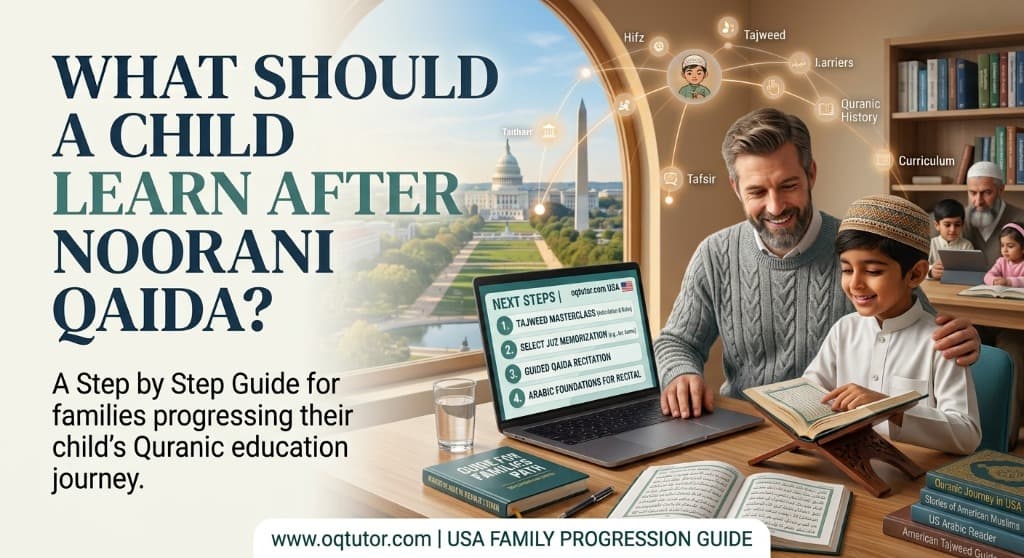
Completing Noorani Qaida is a celebrated milestone, but it marks the beginning of a child's true Quranic recitation journey. The transition moves progressively from foundational letter phonetics to direct Quran reading, correct pronunciation (Makharij), practical Tajweed application, reading fluency, and eventually memorization (Hifz) or deeper Quranic understanding.
Finishing Noorani Qaidais an important milestone in a child's Quran learning journey. But many parents wonder what comes next.
Should the child start reading the Quran immediately? Is Tajweed necessary at this stage? Should memorization begin now, or should the child focus on fluent reading first?
There is no single path that works for every child. The next step usually depends on the child's age, reading ability, pronunciation, confidence, and learning goals.
For most beginners, however, the journey moves from basic Arabic letter recognition to Quran reading, correct pronunciation, Tajweed, and eventually memorization or deeper Quran study.
This guide explains what children can learn after Noorani Qaida and how parents can support each stage without making Quran learning feel overwhelming.
What Does Noorani Qaida Teach a Child?
Noorani Qaida gives children the foundation they need to recognize and pronounce Arabic letters and words.
Depending on the method being used, children usually work through core areas such as:
The purpose is not simply to finish the pages. A child should understand the basic sounds and be able to apply what they have learned when they begin reading Quranic words.
Finishing the Qaida Does Not Mean Learning Is Finished
Completing Noorani Qaida is a beginning, not the end of Quran reading education.
Some children can move into Quran reading quickly. Others need additional practice with individual letters, joined words, or pronunciation. If your child still confuses similar letters, reviewing our guide on common Quran reading mistakes children make can help target specific weak areas.
Parents should focus on mastery rather than speed. A child who reads slowly but accurately has a stronger foundation than a child who rushes through lessons without understanding the sounds.
What Should a Child Learn After Noorani Qaida?
For many children, the next major step is learning to read the Quran directly. The transition should be gradual.
Recommended Quran Learning Progression Path
Not every child will follow these stages at exactly the same speed. Some students may need more time with reading before moving into advanced Tajweed. Others may already be ready to study pronunciation rules alongside their Quran reading.
1Step 1: Start Reading the Quran
Once a child has a reasonable understanding of the Qaida, they can begin reading directly from the Quran in a dedicated Nazra Quran reading course. At first, the goal should be accuracy rather than speed.
Begin With Short and Familiar Passages
A teacher may start with shorter Surahs or easier passages from Juz Amma (Juz 30). This allows the child to become comfortable with the appearance of Quranic text.
Children gradually learn how letters and words appear in real Quranic verses rather than isolated exercises in a Qaida.
Expect Some Mistakes
It is normal for a child to make mistakes when making this transition:
- They may pause frequently between words.
- They may confuse similar-looking letters (such as Ba, Ta, Tha, or Jeem, Haa, Khaa).
- They may forget a pronunciation or vowel rule they previously learned.
- They may take longer to read a verse than expected.
This does not necessarily mean they are struggling. Reading improves naturally through regular, patient practice.
2Step 2: Improve Pronunciation
After beginning Quran reading, pronunciation becomes increasingly important. Arabic contains sounds that may be unfamiliar to children who do not speak Arabic at home. A child may recognize a letter correctly but still need help producing its sound accurately from its proper exit point (Makhraj).
Focus on Difficult Arabic Letters
A qualified teacher can identify sounds that require extra practice. For example, children may need additional guidance with letters that have similar sounds (like Seen vs. Saad, or Taa vs. Toa) or require specific positions of the tongue, mouth, or throat (like Ain, Haa, and Qaf).
The goal is not to make children anxious about every mistake. Instead, pronunciation should improve through repetition and gentle correction from an experienced online Quran tutor.
Listen Before Repeating
Children often learn pronunciation more effectively when they hear an accurate example first. A teacher can recite a word or phrase and ask the child to repeat it.
Over time, these corrections become part of the child's natural reading rhythm.
3Step 3: Begin Learning Tajweed
Tajweed is the next important area for children who are developing their Quran recitation. Tajweed teaches students how to pronounce Quranic letters and apply recitation rules correctly. It is not something that children have to master overnight.
Tajweed Should Be Introduced Gradually
Children can learn Tajweed rules according to their age and ability. A teacher may introduce one rule (such as Ghunnah, Qalqalah, or Madd), demonstrate it, and then allow the child to practice it in actual Quranic verses.
This is usually easier than giving a young learner a long list of rules to memorize. If you want a structured overview of foundational recitation principles, explore our beginner's guide to mastering Tajweed rules at home.
Connect Rules With Actual Reading
Tajweed becomes more meaningful when children can see and hear it during Quran reading. Instead of learning rules only as theoretical definitions, students can practice them in the verses they are already reading. This helps turn knowledge into a practical skill.

Connecting Tajweed rules directly to actual reading passages helps children turn theoretical phonetics into fluent, beautiful recitation.
4Step 4: Build Reading Fluency
Accuracy is important, but children also need to become comfortable reading continuously. Fluency does not mean reading as quickly as possible. It means being able to move through verses with fewer unnecessary pauses while maintaining correct pronunciation and breath control.
Read a Little Every Day
Short daily practice can be more useful than occasional long sessions. A child might read a small portion regularly (15 to 20 minutes) and gradually increase the amount as confidence improves.
Consistency matters far more than trying to complete a large amount in one sitting. For parents managing busy routines, check our advice on how to help children balance Quran learning with school and extracurricular activities.
Don't Turn Reading Into a Race
Children have different learning speeds. Comparing one child with another can make Quran learning stressful. A better approach is to compare the child's current ability with their own previous progress.
If a child reads more confidently this month than last month, that is meaningful progress.
5Step 5: Strengthen Memorization Skills
Once a child becomes comfortable with Quran reading, memorization can be introduced or developed further in our structured Quran memorization (Hifz) course.
Some children may already have memorized short Surahs before completing Noorani Qaida. Others may begin memorization after developing stronger reading skills. Both situations can be appropriate.
Start With Manageable Portions
Young learners generally benefit from manageable memorization targets. A teacher may assign a small number of verses or a short Surah rather than expecting the child to memorize large portions immediately. The objective is to build a sustainable, lifelong habit.
To discover proven memorization strategies, read our guide on effective Hifz memorization techniques for children.
Revision Is Just as Important
Memorizing something once does not mean it has been permanently learned. Regular revision helps children retain what they have memorized. A simple routine can include:
- Review previously memorized Surahs first.
- Practice the current lesson.
- Recite the new portion to the teacher.
- Correct mistakes immediately.
- Review again later during the day.
This balance between new memorization and revision is especially important as the memorized portion becomes larger. Learn more about maintaining revision habits in our article on how to build a consistent Hifz revision routine.
6Step 6: Understand What the Child Is Reading
Reading the Arabic text is only one part of Quran learning. As children grow older and their language skills develop, parents may also introduce the meaning and basic explanation of what they read through Quran translation and Tafseer.
Start With Simple Meanings
Children do not necessarily need complicated explanations. Simple age-appropriate discussions can help them understand the message of a Surah. For example, a teacher may explain the central theme of a short Surah from Juz Amma and discuss the lessons it contains. This makes Quran learning deeply personal and inspiring.
Connect Learning With Everyday Life
Children often understand lessons better when they can connect them with familiar situations. A discussion about kindness, patience, honesty, gratitude, or responsibility can help them see that Quran learning is not limited to reading practice.
This holistic moral growth can be further supported through an age-appropriate Islamic Studies program for kids.
How Long Does It Take to Move Beyond Noorani Qaida?
There is no fixed timeline. One child may be ready to begin Quran reading after several months of structured learning. Another may need additional practice before making the transition.
Factors that can affect progress include:
The teacher should assess the child's ability instead of moving them forward simply because a certain number of lessons has been completed. For detailed developmental milestones, see our guide on how long it takes for a child to complete the Quran online.
Signs Your Child May Be Ready for Quran Reading
Parents can look for several practical readiness indicators before beginning full Quran recitation:
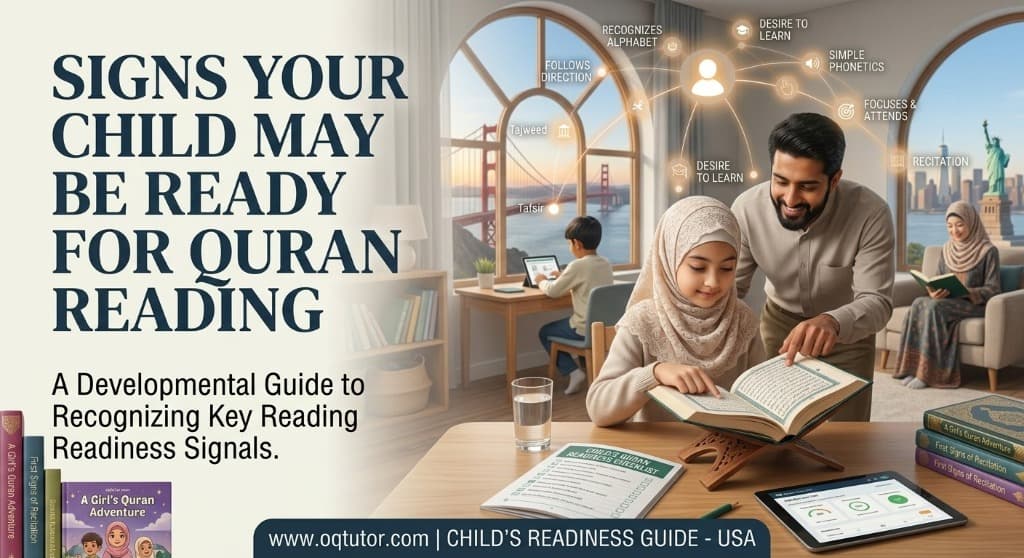
Developmental readiness signals help parents and teachers determine when a child can transition smoothly from Qaida into direct Quran recitation.
1. Your Child Recognizes Arabic Letters
The child should be able to identify common Arabic letters in all their forms (isolated, initial, medial, and final) without constantly needing prompts.
2. Your Child Can Read Basic Joined Words
The child should have some confidence reading multi-letter combinations and short words rather than only individual letters.
3. Your Child Understands Basic Reading Marks
They should have a working understanding of the basic vowel signs (Harakat), Sukoon, Shaddah, and Tanween introduced during Qaida lessons.
4. Your Child Can Apply Corrections
If the teacher corrects a pronunciation or reading mistake, the child should gradually be able to listen and repeat it correctly.
5. Your Child Is Becoming More Confident
Confidence matters. A child does not need perfect reading before beginning Quran study, but they should have enough foundation to make the transition productive.
If you are assessing readiness for a younger child, check our detailed article on how do you know your child is ready to start learning the Quran.
What If My Child Still Struggles After Noorani Qaida?
There is no reason to rush. Sometimes a child completes the Qaida but still has difficulty with particular letters, joining words, or reading marks. In that situation, targeted revision can help.
Identify the Exact Problem
Instead of repeating the entire Qaida from page one, the teacher can identify the specific areas causing difficulty. For example, the child may only need extra practice with:
- Similar-sounding letters (Makharij precision)
- Madd (stretching rules)
- Shaddah (doubled consonant pauses)
- Sukoon (consonant connections)
- Tanween (double vowel sounds)
- Joined word recognition
- Pronunciation consistency
Focused, targeted practice makes lessons far more efficient and prevents student frustration.
How Parents Can Support the Next Stage
Parents do not need to become expert Quran teachers to support their child's progress. Their role can be simple, encouraging, and consistent.
Create a Regular Practice Time
Choose a fixed time that works with your family routine. A short period of 15 to 20 minutes of focused practice each day is enough for many children.
Listen to the Child Read
Even 5 to 10 minutes of listening shows parents where the child feels confident and where additional help from the teacher may be needed.
Encourage Rather Than Pressure
Children respond differently to correction. Positive encouragement and warm praise help them stay motivated while developing a new skill.
Stay Connected With the Teacher
Ask simple check-in questions: What is my child working on now? Which area needs practice? Is my child ready for the next stage?
Should Children Learn Tajweed Before or After Quran Reading?
Tajweed and Quran reading do not always have to be completely separate stages.
A child can begin applying basic Tajweed principles while developing Quran reading skills. The exact sequence depends on the student's ability and the teacher's approach.
The important point is that Tajweed should support correct recitation rather than make learning unnecessarily complicated.
What Comes After Basic Quran Reading?
Once a child can read more confidently, learning can become broader and more enriching. Depending on the child's goals, the next areas may include:
Advanced Tajweed
The child can continue developing precise pronunciation, rules of stopping (Waqf), letter characteristics (Sifaat), and advanced elongation.
Quran Memorization (Hifz)
Students interested in Hifz can gradually increase memorization from Juz Amma while maintaining regular daily revision under teacher supervision.
Translation & Tafseer
Older children can begin studying simple word-by-word translations and explanations of the Surahs they recite during daily prayers.
Islamic Studies
Quran recitation is complemented with Islamic manners (Adab), daily Duas, Prophetic stories (Seerah), and the fundamentals of Salah.
The right combination depends on the child's age, interests, and family goals.
Online Quran Classes After Noorani Qaida
Online learning can make the transition easier for families who want regular one-to-one instruction. A live teacher can listen to the child's recitation, identify mistakes, and provide immediate correction. This is especially useful when pronunciation needs individual attention.
One-to-One Lessons
Individual lessons allow the teacher to focus on one student's reading ability rather than following the pace of a group. This can be helpful when a child needs extra practice in a particular area. Explore our directory of certified male and female Quran tutors.
Flexible Scheduling
Families can choose lesson times that fit around school, homework, family activities, and other commitments. A consistent schedule can make it easier for children to maintain their Quran learning routine. Check our transparent pricing and schedule packages.
A Simple Learning Path for Parents
If you are unsure what your child should study next, this simple progression can help:
Complete the Noorani Qaida Foundation
Master letter recognition, short vowels, Sukoon, Shaddah, and basic word joining.
Begin Reading Directly From the Quran
Start with Juz Amma short Surahs focusing on steady accuracy over speed.
Correct Pronunciation & Reading Mistakes
Refine letter exits (Makharij) through listen-and-repeat guided correction.
Introduce and Practice Tajweed
Apply Ghunnah, Qalqalah, and elongation directly within recited verses.
Build Reading Fluency
Establish a 15-20 minute daily reading habit without rushing or comparison.
Add Memorization (Hifz)
Memorize short Surahs alongside a disciplined daily revision schedule.
Introduce Translation & Islamic Studies
Explore Surah meanings, daily Duas, Islamic values, and character development.
The stages can overlap. A child may practice Tajweed while improving Quran reading or memorize short Surahs while continuing to work on fluency.
Frequently Asked Questions
Q1:What should a child learn after Noorani Qaida?
Most children can move toward direct Quran reading after building a solid foundation in Noorani Qaida. Pronunciation, Tajweed, fluency, and memorization can then be developed according to the child’s ability.
Q2:Should my child start Tajweed after Noorani Qaida?
Yes, basic Tajweed can be introduced as the child begins Quran reading. The teacher can gradually apply appropriate rules rather than teaching everything at once.
Q3:How long does it take to learn Quran after Noorani Qaida?
There is no universal timeline. Progress depends on age, ability, lesson frequency, home practice, and individual learning needs.
Q4:Should children memorize Quran after learning to read?
Memorization can begin once a child has enough reading ability to recite the assigned passages accurately. The amount should match the child’s age and learning capacity.
Q5:What if my child completed Noorani Qaida but still reads slowly?
Slow reading is common during the transition. Regular practice and targeted correction can gradually improve accuracy and confidence.
Q6:Can my child learn Quran online after Noorani Qaida?
Yes. Live online lessons can provide individual reading practice, pronunciation correction, Tajweed instruction, and memorization support from home.
Final Thoughts
Completing Noorani Qaidais an important achievement, but it is only one step in a child's Quran learning journey.
The next goal should not simply be to finish more pages. It should be to develop accurate reading, clear pronunciation, confidence, Tajweed awareness, and a consistent relationship with the Quran.
For some children, the next step will be direct Quran reading. For others, additional Qaida practice may be helpful. With the right guidance, both can lead to steady progress.
Parents can support this journey by creating a regular routine, encouraging practice, and staying connected with the child's teacher.
Most importantly, allow the child to progress at a pace that builds confidence rather than pressure. With patience and consistent practice, Noorani Qaida can become the foundation for a much deeper and more rewarding Quran learning journey.
Ready for Your Child's Next Quran Learning Step?
Book a free placement trial class with certified male or female Quran teachers. Personalized 1-on-1 guidance from Noorani Qaida to fluent recitation.

Muhammad Imran
Author & Senior ScholarSenior Tajweed & Hifz Scholar • Jamia Ashrafia Graduate
Muhammad Imran is a certified Tajweed and Quran memorisation scholar at OQTutor with over 5 years of international teaching experience guiding young children and adult beginners through Noorani Qaida, accurate Makharij, and complete Quran recitation.