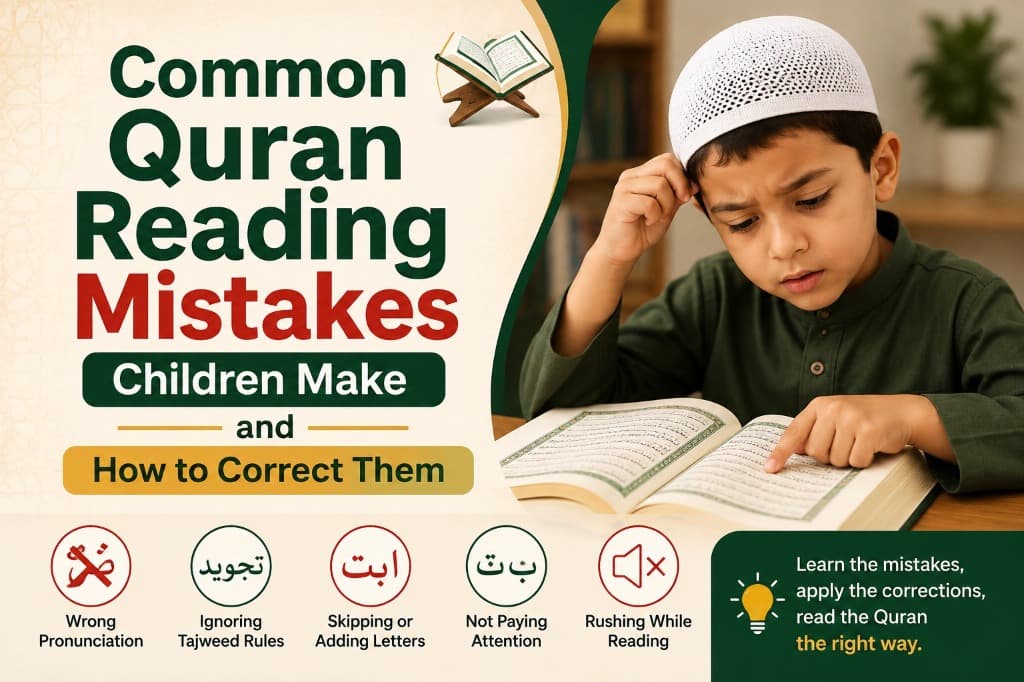
Learning to read the Quran is a step-by-step journey where mistakes are a completely natural part of the process. The key is early, gentle identification before errors turn into deep habits. By addressing similar-looking letters, throat makharij, short vowels, and memorization dependency through structured Noorani Qaida and live one-on-one Quran reading guidance, children develop lasting confidence and authentic Tajweed.
Learning to read the Quran is a gradual journey. Children do not become confident reciters overnight, and making mistakes is a normal and necessary part of learning.
The important thing is to identify mistakes early, correct them gently, and give children enough structured practice to build accurate, lasting reading habits.
Some children struggle with similar-looking Arabic letters. Others confuse short and long vowel sounds, rush through words, stop at the wrong places, or pronounce certain letters incorrectly. These problems can become harder to change if they are repeated for months without correction.
The good news is that most reading difficulties can improve quickly with patient instruction, regular practice, and appropriate guidance.
Quick Answer: What Are the Most Common Quran Reading Mistakes Children Make?
Children commonly make mistakes with Arabic letter pronunciation, similar-looking letters, vowel sounds, letter connections, elongation (Madd), stopping and starting (Waqf), and basic Tajweed rules.
The best way to correct these mistakes is to identify the exact problem, practice it separately, then apply the correction while reading Quranic words and verses. A qualified Quran teacher can listen to a child's recitation and provide immediate correction rather than allowing an incorrect pronunciation to become a permanent habit.
“The one who is proficient in the recitation of the Qur'an will be with the honorable and obedient scribes (angels), and he who recites the Qur'an and finds it difficult, and stammers over it, will have a double reward.”
Confusing Similar-Looking Arabic Letters
Arabic contains letters that can look remarkably similar, particularly to young beginners learning Arabic as a second language.
For example, children may initially confuse letter families such as:
The dots and articulation points are vital. Simply recognizing the general outline or curve of a letter is not enough for accurate recitation.
How to Correct It
Practice similar letters side by side rather than teaching them in isolation weeks apart. Ask the child to:
- Identify the letter: Look at where the dots are placed (above or below).
- Say its sound: Articulate the phonetic sound clearly.
- Compare it: Contrast it directly with its sibling letter.
- Read with vowels: Apply Fathah, Kasrah, and Dammah.
- Read in a word: Spot it at the beginning, middle, and end of a word.
Short, repeated practice is far more effective than trying to memorize a large batch of letters at once. Children developing their foundation benefit immensely from structured Noorani Qaida instruction before moving into longer Quran passages. (See our guide on why Noorani Qaida is essential for Quran recitation).
Mispronouncing Letters From the Throat or Mouth (Makharij)
Some Arabic letters require articulation points (Makharij) that do not exist in the English alphabet. This is especially challenging for children raised in Western and English-speaking environments.
Letters such as ح ، خ ، ع ، غ ، ق demand specific muscle coordination in the deep throat, middle throat, and back of the tongue. A child might recognize the letter visually on the page but substitute an easy English sound (such as pronouncing ح as a soft English 'h', or عas a plain 'a').
How to Correct It
Avoid simply telling a child, “That's wrong.” Instead, follow this guided coaching method:
- Demonstrate the sound: Produce the exact sound clearly at a slow pace.
- Explain the origin: Explain where the sound comes from (e.g. middle of the throat vs back of the mouth).
- Active listening: Have the child listen carefully before they try to speak.
- Slow repetition: Ask them to repeat it three times slowly.
- Vowel variations: Practice the letter with Fathah, Kasrah, and Dammah.
Pronunciation is nearly impossible to master from reading text alone. OQTutor's Quran Reading curriculum integrates Arabic letter articulation points as an essential core foundation. Read our detailed guide on common pronunciation mistakes in Noorani Qaida and how to fix them.
Confusing Short Vowels (Harakat)
Arabic vowel marks (Harakat) determine the exact meaning and grammatical structure of Quranic words. Children often confuse the three primary short vowels:
- Fathah ( َ ) — ‘a’ sound above the letter
- Kasrah ( ِ ) — ‘ee/i’ sound below the letter
- Dammah ( ُ ) — ‘oo/u’ sound above the letter
A child may identify the consonant accurately (such as ‘Baa’) but guess the vowel randomly because they are rushing or looking only at the letter shape.
How to Correct It
Step back from longer verses and isolate vowel patterns:
The goal is helping the child connect the visual symbol (stroke above, stroke below, curl above) with its corresponding sound automatically without hesitation.
Making Errors With Sukoon (Jazm) and Shaddah (Tashdeed)
Sukoon ( ْ ) indicates the absence of a vowel, while Shaddah ( ّ ) indicates that a letter is doubled—the first instance carrying a Sukoon and the second carrying a Harakah.
Young readers frequently struggle here because their attention is focused on recognizing single letters. They may either overlook the Sukoon entirely (adding an accidental vowel sound) or pronounce a Shaddah letter as a weak, single letter without the necessary emphasis and hold.
How to Correct It
Practice marked letters slowly in two-letter words first before combining them into longer Quranic words. For Shaddah, teach the child that the tongue “parks” on the letter momentarily for emphasis before releasing into the vowel. Avoid overwhelming young learners with complex grammatical terms early on—focus first on the physical acoustic rhythm.
Stretching Letters for Too Long or Not Long Enough (Madd Rules)
Another frequent stumbling block is Madd, or elongation.
Some children stretch vowels randomly whenever they want their recitation to sound melodious. Others read every single vowel with the exact same flat length, failing to distinguish between a 1-count short vowel and a 2-count, 4-count, or 6-count Madd. Neither extreme produces correct Quranic recitation.
How to Correct It
Teach children to recognize the letters of Madd (Alif preceded by Fathah, Yaa preceded by Kasrah, and Waaw preceded by Dammah) along with special wavy Madd symbols. Start with controlled 2-count exercises using rhythmic finger counting before introducing extended 4 to 6-count Madd.
OQTutor's structured Tajweed curriculum breaks down Madd into clear, bite-sized rules so students master duration with precision and confidence. Learn more in our beginner guide to mastering Tajweed rules.
Rushing Through Words and Verses
Many young students mistakenly believe that reading quickly is proof of reading well. When a child rushes, they often:
- Skip intermediate sounds and Tanween
- Miss vowel indicators
- Ignore essential Tajweed rules
- Slur letter exits unclearly
- Gasp for breath and stop abruptly without regard to meaning
Always master accuracy on a short passage before allowing reading speed to increase. Natural fluency always follows precision; speed without precision only reinforces bad habits.
Stopping in the Wrong Place (Waqf and Ibtida')
Children frequently stop whenever they run out of breath, hit a difficult multi-syllable word, or simply feel like pausing. However, Quranic recitation has precise rules governing where stopping (Waqf) and restarting (Ibtida') are permissible to preserve the sacred meaning.
How to Correct It
Introduce basic Waqf symbols gradually (such as مـ for compulsory stop, ج for permissible stop, and لا for do not stop). Teach children that punctuation marks in the Mushaf carry meaning. A live teacher demonstrates where to breathe, when to go back one or two words before continuing, and how stopping at proper junctures preserves the beauty and message of the Ayah.
Ignoring Basic Tajweed Rules
A child may become reasonably comfortable pronouncing individual Arabic letters while still ignoring fundamental Tajweed rules such as:
How to Correct It
Do not teach every rule simultaneously. Introduce one concept at a time using a 3-week progressive habit timeline:
For children who need systematic guidance, OQTutor offers a dedicated Quran with Tajweed program covering articulation, recitation rules, and practical application.
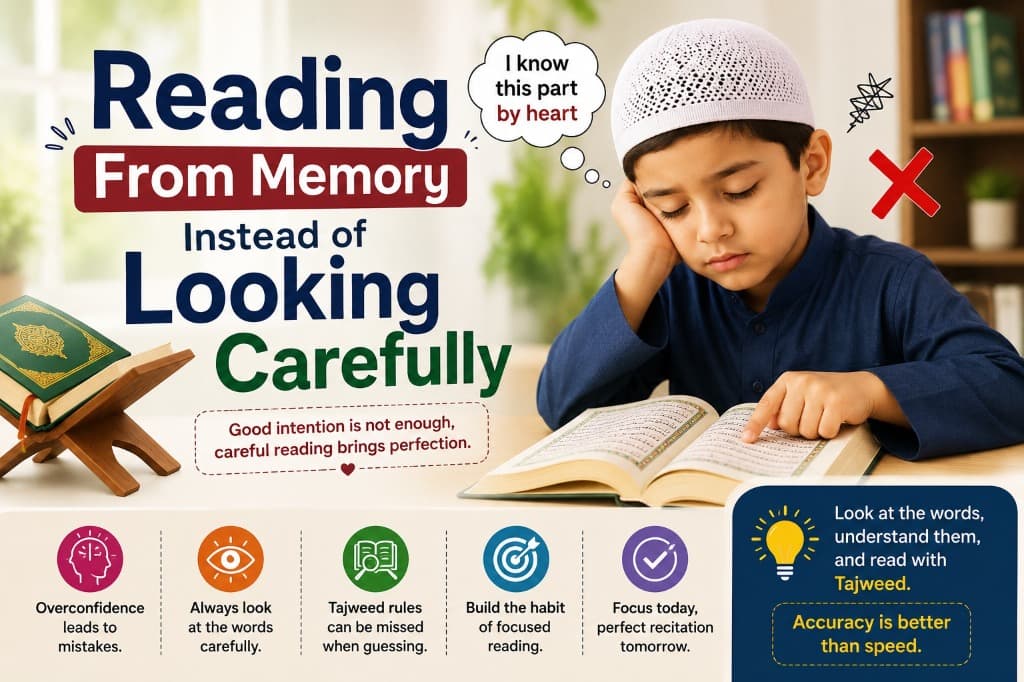
Reading From Memory Instead of Looking Carefully
Children who have memorized short Surahs from Juz Amma often recite rapidly from memory while barely looking at the Mushaf in front of them.
Memorization is a profound blessing, but relying completely on memory can mask severe reading weaknesses. A child may know what comes next purely from auditory memory without actually recognizing the written Arabic letters or Harakat on the page.
How to Test and Correct It: The Mushaf Diagnostic Checklist
Periodically test your child by pointing to a random Ayah or asking them to track each word with their finger. This evaluates six vital foundational skills:
Can they recognize individual words without rhythm cues?
Can they spot middle and end letter forms?
Are short vowels read accurately without guessing?
Does the voice match what the eye is seeing?
Are pronunciation rules applied deliberately?
Does the finger move in sync with recitation?
Repeating the Same Mistake Without Realizing It
Perhaps the single biggest obstacle in Quran learning is not making a mistake once—it is repeating that mistake dozens of times until the incorrect sound feels normal and automatic.
Children cannot easily hear their own pronunciation errors because the inaccurate sound has become their internal benchmark.
The 5-Step Immediate Gentle Correction Protocol
- Pause immediately: Stop the student gently right where the error happened.
- Model the correct sound: The tutor pronounces the correct word clearly twice.
- Student repetition: Have the child repeat the word slowly.
- Read in context: Re-read the entire sentence with the corrected word.
- Spiral review: Return to that exact word later in the lesson.
This is why personalized one-on-one instruction with a dedicated tutor is so valuable. In a private lesson, the teacher addresses the child's exact weaknesses rather than moving ahead at a group pace. Browse our verified male and female Quran tutors.
How Can Parents Help Children Improve Quran Reading at Home?
Parents do not need to be certified Quran scholars to support their child's reading progress. A consistent, encouraging home environment makes a tremendous difference.
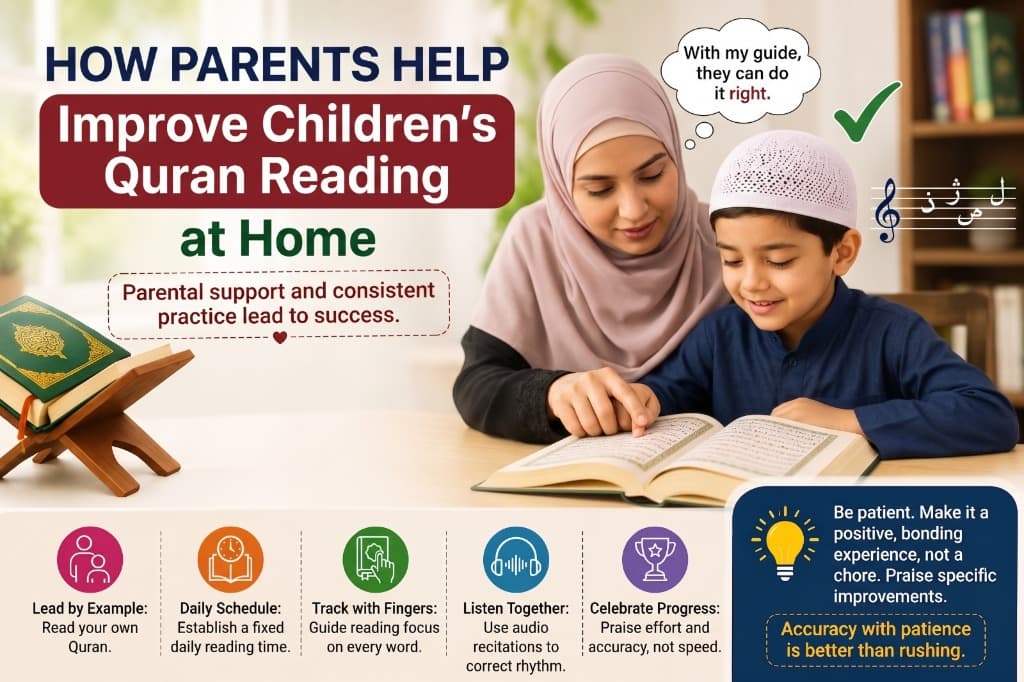
Ten focused minutes every day is far more productive than an exhausting 45-minute marathon once a week when a child is tired or frustrated.
Silent reading hides pronunciation errors and skipped vowels. Listening to your child recite aloud makes it easy to spot confusion early.
Target the two most frequent errors per session. Over-correcting ten things at the same time can make a child anxious and reluctant to read.
Instead of saying “You keep making this mistake,” say: “That letter sounded much clearer today! Let's practice it once more.” Confidence creates resilience.
When your tutor identifies a specific letter or Tajweed rule for homework, reinforce that exact skill during home practice. Alignment between teacher lessons and home review accelerates results. Read our guide on how to know if your child is ready to start Quran.
A Simple 10-Minute Daily Quran Practice Routine
Parents looking for a practical, low-stress routine can implement this 10-minute structured framework:
Focus on 1 or 2 difficult letters (e.g. ح vs ه or ع vs ء) with different vowel marks.
Read 5 to 10 isolated words containing those target letters to build phonetic accuracy.
Read a short passage or half a page slowly from the Mushaf, tracking with a finger.
Revisit only the specific words where hesitation or mistakes occurred.
Highlight one specific improvement made during the session and end with high spirits.
When Should a Child Learn Tajweed?
Children do not need to wait until they are advanced readers before learning Tajweed. Basic pronunciation and core articulation rules are introduced progressively as their reading foundation develops.
However, instruction must match the child's developmental capacity. A beginner struggling with letter shapes needs foundational phonics first. A child who can read connected words fluently is ready for structured Tajweed rules.
OQTutor's progressive pathway separates foundational Noorani Qaida from intermediate Quran reading and advanced Tajweed rules, allowing every child to advance at their personal pace. See our guide on realistic Quran completion timelines for children.
When Should Parents Consider a Qualified Quran Teacher?
Consider getting professional teacher support when a child:
For young learners, our specialized online Quran classes for kids feature gentle, child-friendly certified male and female scholars who turn reading into an engaging and joyful experience.
Frequently Asked Questions
What are the most common Quran reading mistakes in children?
Common mistakes include confusing similar Arabic letters, incorrect throat pronunciation (Makharij), vowel errors (Harakat), problems with Sukoon and Shaddah, incorrect elongation (Madd), rushing through verses, stopping in wrong places (Waqf), and reciting from memory without looking at the text.
How can I improve my child's Quran reading at home?
Use short 10-minute daily practice sessions, encourage reading aloud, focus on one or two specific mistakes per session, repeat tricky words, and seek qualified teacher feedback when pronunciation challenges persist.
At what age should children start learning Quran reading?
There is no single mandatory age. Most children begin gentle Noorani Qaida phonics between ages 4 and 6. Readiness—such as paying attention for 5 to 10 minutes and repeating sounds—matters much more than a calendar date.
Should children learn Tajweed while learning to read Quran?
Yes, basic Tajweed concepts can be introduced progressively as children develop their reading foundation. Children still learning alphabet letters focus on pronunciation first before tackling theoretical rules.
Can an online Quran teacher correct my child's pronunciation?
Yes. In live one-on-one classes, an expert teacher listens to the child's recitation in real time, spots pronunciation and articulation errors instantly, and guides the student with visual tools. To find a vetted program with US time-zone flexibility, review our comparison guide to the best online Quran classes for kids in the USA.
Is Noorani Qaida useful for children who struggle with Quran reading?
Yes. Noorani Qaida provides a structured, phonetic foundation for Arabic letters, vowel marks, letter connections, and rhythm before a student progresses to longer Quranic passages.
How long does it take for a child to improve Quran reading?
Progress depends on consistency, starting level, and practice habits. With regular 3 to 4 short sessions weekly and teacher feedback, children show noticeable improvement within weeks.
Final Thoughts
Quran reading mistakes are a natural part of learning. The goal is not to make children fearful of errors, but to help them recognize, correct, and replace them with accurate recitation habits.
The most effective approach combines patient teaching, regular practice, immediate gentle correction, and warm encouragement.
Start with the basics. Focus on one or two problems at a time. Give your child enough repetition to build confidence, and avoid turning Quran practice into a source of pressure.
For families across the United States and worldwide seeking structured support, explore our complete comparison guide to online Quran classes for kids in the USA (including US time zone scheduling and pricing comparisons), or check out our dedicated regional hub for OQTutor Online Quran Classes USA offering personalized pathways for Quran Reading, Tajweed, and Noorani Qaida.
Book a Free Assessment & Trial Quran Class for Your Child
Experience gentle, live 1-on-1 recitation correction with verified male and female scholars. Free trial, no obligation.