
Balancing Quran study with school and extracurriculars is not about cramming an impossible schedule. It is built on realistic expectations, consistent short sessions, proactive communication with tutors, and protecting essential rest. By integrating flexible online Quran classes for kids into your weekly rhythm, children cultivate a joyful, lasting bond with the Holy Quran without burnout.
Children today have a lot on their plates. School brings homework and projects. Sports bring practices and games. Music lessons, hobbies, friends, family time, and screen time all compete for attention.
For Muslim parents, there is another important priority: helping children learn and connect with the Quran.
The challenge is not choosing between Quran learning, school, and extracurricular activities. The real goal is creating a routine where each part of a child's life has an appropriate place.
A successful Quran learning routine should support a child's education, wellbeing, family life, and Islamic development rather than making the child feel constantly busy.
The good news is that balance does not require a perfect schedule. It requires realistic expectations, consistent routines, and enough flexibility to adapt when life gets busy.
Why Balance Matters for Children
Children learn best when they have time for different types of experiences.
School develops academic knowledge. Sports and physical activities support fitness and teamwork. Hobbies allow children to explore their interests. Quran learning develops their relationship with the Quran and Islamic values.
These activities do not have to compete with each other.
The Centers for Disease Control and Prevention (CDC) recommends that children and teenagers between 6 and 17 years old get at least 60 minutes of physical activity each day. The CDC also notes that regular physical activity can support cognition, memory, and academic performance.
That means parents should not treat every minute outside school as study time. Children need opportunities to move, play, relax, socialize, and enjoy childhood.
The same principle applies to Quran learning.
A child who associates the Quran with constant pressure may struggle to develop a positive long term relationship with learning. A child who experiences Quran learning as a meaningful and manageable part of daily life can gradually build consistency.
Start With Your Child's Real Schedule
One of the biggest mistakes parents make is creating a schedule based on an ideal day rather than the child's actual day.
Before adding Quran classes, look at everything your child already does. Write down:
School Commitments
Include school hours, homework, projects, tests, and travel time.
Extracurricular Activities
Include football, basketball, swimming, martial arts, music, art, tutoring, clubs, and other regular commitments.
Family Responsibilities
Consider meals, family time, household responsibilities, mosque activities, and religious events.
Rest and Personal Time
Children also need unstructured time. They should not feel that every hour of their day has an assignment attached to it.
Once you see the complete picture, you can identify realistic spaces for Quran learning.
This simple exercise often reveals that the problem is not a lack of time. The problem is that the available time has never been organized properly.
Choose Consistency Over Long Sessions
For many children, a short and consistent Quran lesson can be easier to maintain than occasional long sessions.
Parents should consider their child's age, attention span, current Quran level, school workload, and overall routine when deciding how frequently lessons should occur.
The objective should not be to fill the calendar with Quran classes. The objective should be to create regular contact with the Quran.
For example, a family may find that Quran reading lessons work well after homework on certain weekdays. Another family may prefer lessons earlier in the afternoon or during quieter weekend periods with Tajweed practice.
There is no universal schedule that works for every child.
The best schedule is one that the child can follow consistently without sacrificing sleep, school responsibilities, physical activity, or healthy family time.
Build a Weekly Family Schedule
A weekly schedule can make balancing Quran learning much easier.
Instead of deciding every day when the child will study, choose regular Quran learning periods in advance. For example:
The exact arrangement will depend on your family.
The important idea is to avoid treating Quran learning as something that must somehow fit into the remaining minutes of the day. Give it a predictable place in the family routine.
Coordinate Quran Learning With School Demands
School workload changes throughout the year. A normal school week may feel manageable, while exam periods can suddenly become much more demanding.
Parents should recognize these changes rather than expecting identical Quran performance every week.
During a lighter academic period, a child may have more energy for Quran reading, memorization (Hifz), or Tajweed practice.
During exams, parents might temporarily reduce additional Quran practice while maintaining the core routine.
This does not mean abandoning Quran learning. It means adjusting the workload intelligently.
The same approach can apply when children have major projects, competitions, sports tournaments, or important performances. Balance sometimes means changing the routine instead of forcing the routine to remain unchanged. For more guidance on pacing, see our detailed guide on how long it takes for a child to complete the Quran online.

Smart scheduling aligns academic school demands with Quran learning without compromising child wellbeing.
Use Short Quran Practice Sessions
Quran learning does not always need to happen during a formal lesson. Parents can create small opportunities throughout the week.
A child might review previously learned verses for a few minutes after school. Another child may practice reading before bedtime. A parent might listen while the child reads during a quiet family moment.
Small review sessions can help reinforce what the child learned during a formal Quran class.
The key is to keep the practice focused. Instead of saying, “Go practice Quran,” give the child a specific task:
Clear instructions make practice feel more manageable and prevent frustration. If your child is beginning from scratch, starting with Noorani Qaida phonics ensures short, confident practice sessions every day. You can also explore our guide on common Quran reading mistakes children make and how to fix them.
Protect Sleep and Rest
A balanced schedule must include adequate rest.
If a child regularly finishes homework late, attends activities in the evening, completes a Quran lesson, and then stays up even later to finish schoolwork, the schedule needs adjustment.
Parents should not measure success by the number of activities they can fit into one day. A healthy routine should allow children to learn without constantly feeling exhausted.
The American Academy of Pediatrics (AAP) recommends creating family routines that protect time for healthy activities and reduce unnecessary digital distractions. Its Family Media Plan encourages families to establish screen-free periods and make room for activities such as reading, outdoor play, hobbies, and family interaction.
This is particularly useful when online Quran classes take place on a tablet or computer. The device should serve the lesson rather than become an invitation to open five other apps.
Reduce Digital Distractions
Online Quran classes can offer flexibility, but the learning environment matters.
Before class begins, encourage your child to:
The American Academy of Pediatrics recommends screen-free times and places and suggests reducing distractions such as unnecessary notifications.
A focused twenty-minute learning session can be far more productive than a longer lesson filled with interruptions.
Let Children Have a Voice in Their Routine
Children are more likely to cooperate with a routine when they understand it and have some input.
Ask questions such as:
This does not mean children should control every part of the schedule. Parents still provide structure and guidance. However, giving children appropriate choices can make the routine feel collaborative instead of imposed.
Harvard University's Center on the Developing Childemphasizes the importance of responsive interactions (“serve and return”) between children and caring adults. Such interactions help support children's cognitive development and provide a vital foundation for lifelong learning and emotional wellbeing.
Avoid Turning Quran Learning Into a Competition
Every child learns at a different pace.
One child may memorize quickly. Another may need more repetition. One child may enjoy Tajweed while another enjoys Quran stories or understanding meanings.
Comparing siblings or classmates can create unnecessary pressure.
“Your brother memorized this Surah much faster.”
“You have improved so much in your pronunciation compared with last week!”
Specific encouragement helps children recognize progress. Praise effort, consistency, careful reading, and improvement rather than only praising the amount memorized.
This approach helps children understand that Quran learning is a rewarding lifelong journey. Check our guide on how do you know your child is ready to start learning Quran for additional milestones.
Make Quran Learning Meaningful
Children are naturally curious. They may want to know what a verse means, why a particular word appears repeatedly, or how a Quranic teaching applies to everyday life.
Do not make every Quran interaction about correcting mistakes.
Sometimes ask your child what they understood. You could discuss a simple lesson from a Surah during dinner or connect an Islamic value with something happening at school through an Islamic Studies course.
Harvard's research on responsive interactions highlights the value of following a child's interests and engaging in meaningful back-and-forth communication. The Quran should never feel like another dry worksheet that disappears into the school backpack.
Adjust the Routine During Busy Seasons
Some weeks will simply be busy.
During Ramadan, school examinations, sports competitions, family travel, or major school projects, your child's routine may need temporary changes.
Instead of asking, “How can we maintain the exact same schedule?” ask: “What is realistic for our family this week?”
You might reduce the amount of independent review, move a lesson to another day, or focus on maintaining basic Quran reading until the busy period ends.
Once the demanding period passes, gradually return to the normal routine. Flexibility prevents temporary challenges from becoming long term frustration.
Watch for Signs of Overload
Parents should pay attention to changes in their child's behavior. Possible signs that the schedule needs adjustment include:
One sign alone does not automatically mean that the schedule is too demanding. However, repeated patterns deserve attention.
The solution may simply involve reducing commitments, changing lesson timing, creating more rest, or speaking with the child's teacher.
Work With the Quran Teacher
Parents do not have to manage everything alone.
A good Quran teacher can help parents understand what the child needs to practice between lessons and how much work is realistic.
Communication becomes especially important when school becomes demanding. Parents can tell the teacher:
This information helps the teacher adjust expectations appropriately.
For families using online Quran classes, one major advantage is that lessons can often fit more easily around school and extracurricular commitments because children can learn from home without commuting. Discover our tips on how to select the right online Quran tutor and how to keep kids motivated in online Quran classes.
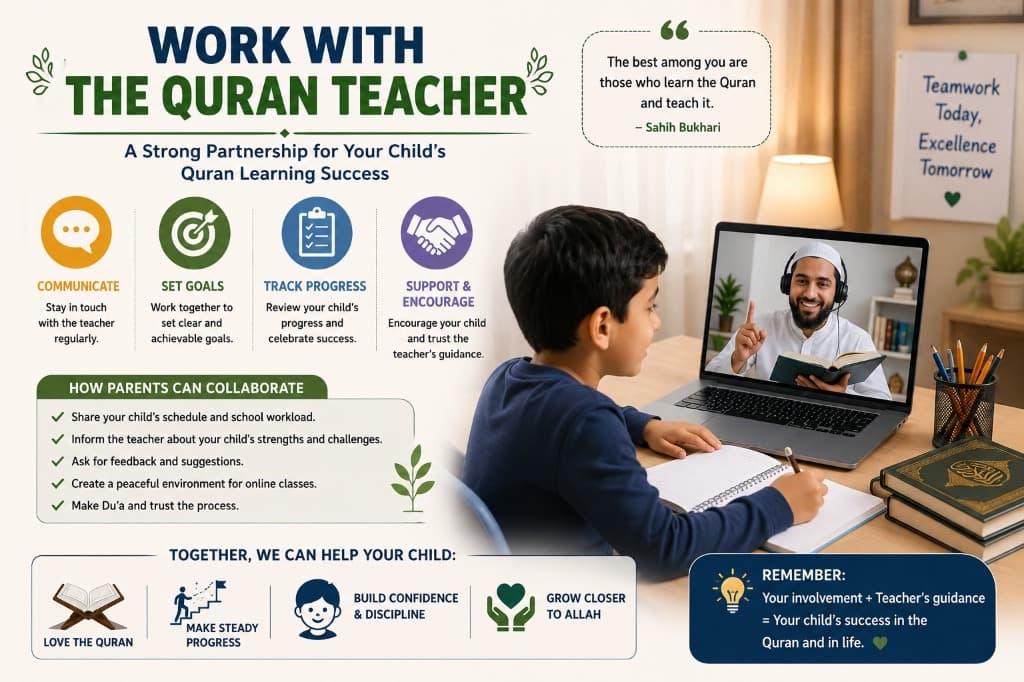
A strong partnership between parents and certified Quran tutors fosters steady progress and joyful Islamic learning.
A Simple Balance Formula for Parents
When planning your child's week, think about five core areas:
School
Academic responsibilities come first during school hours and major exam periods.
Quran
Maintain regular and realistic Quran learning at a steady, manageable pace.
Activity
Give children opportunities for physical activity, sports, and healthy hobbies.
Family
Protect meaningful family meals, discussions, and spiritual bonding.
Rest
Leave enough space for quality sleep, relaxation, and mental recovery.
If one area starts consuming almost all of the child's time, the schedule probably needs adjustment.
Balance does not mean giving every activity exactly the same amount of time. It means giving each important area enough space to support the child's overall development.
Frequently Asked Questions
How can children balance Quran classes with school?
Create a weekly schedule that considers school hours, homework, extracurricular activities, Quran lessons, family time, and rest. Choose consistent Quran learning periods and adjust them during particularly demanding school weeks.
How much time should a child spend learning Quran each day?
There is no single amount that suits every child. Age, Quran level, attention span, school workload, and family routine all matter. Focus on consistent learning (such as 15 to 30 minutes) that your child can maintain without creating unnecessary stress.
Should Quran classes come before or after homework?
Either can work. Some children concentrate better before homework when their energy is high, while others prefer completing school responsibilities first to enjoy a relaxed Quran class. Test both options and observe when your child learns most effectively.
How can parents motivate children to learn Quran?
Use encouragement, realistic goals, positive feedback, and age-appropriate choices. Connect Quran learning with understanding and everyday life rather than focusing only on memorization or correction.
What should parents do when a child becomes overwhelmed?
Look at the entire schedule. Consider reducing unnecessary commitments, changing the timing of Quran lessons, creating more rest, and communicating with the Quran teacher. A temporary adjustment can help the child return to learning with greater focus.
Can online Quran classes help busy families?
Online Quran classes provide great scheduling flexibility because children can learn from home without travelling to another location. However, the class still needs a suitable time, quiet environment, and focused learning routine.
Final Thoughts
Helping children balance Quran learning with school and extracurricular activities is not about creating the perfect timetable. It is about understanding the child behind the timetable.
A successful routine gives children structure without removing flexibility. It encourages Quran learning without making the Quran feel like another source of academic pressure. It protects school responsibilities while leaving room for sports, hobbies, family, rest, and play.
Start small. Choose realistic Quran learning times. Reduce unnecessary distractions. Talk with your child. Communicate with the Quran teacher. Review the schedule when school demands change.
Most importantly, remember that the goal is not simply to make a child complete more lessons. The goal is to help the child build a lasting and positive relationship with the Quran while growing academically, physically, socially, and emotionally.
A balanced routine may require a little planning from parents, but it can make Quran learning much more sustainable for the entire family.
Explore our tailored programs for children and families across the US and worldwide, including Online Quran Classes for Kids in USA, Quran Reading, Tajweed rules, Hifz Quran memorization, and Noorani Qaida foundation at OQTutor USA.
Book a Free Assessment & Trial Quran Class for Your Child
Experience personalized 1-on-1 Quran lessons designed around your child's school schedule. Free trial, flexible times, no obligation.