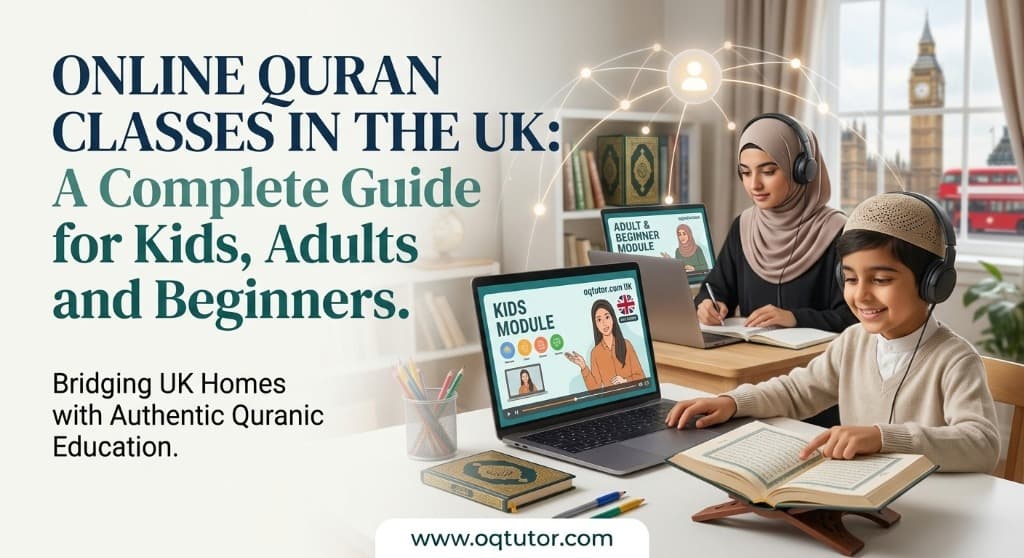
For Muslim families living across England, Scotland, Wales, and Northern Ireland, online Quran classes provide a structured, practical way to organise Quranic education from home. With one-to-one live tuition, students learn at their own pace, receive direct pronunciation guidance, and avoid the commuting challenges of busy British school and work routines.
Finding consistent time for Islamic education can feel daunting for British Muslim families. Between rigorous school timetables, long commutes, after-school sports clubs, GCSE revision, and demanding professional careers, managing regular trips to a local centre or mosque often creates additional household strain.
For many households, online Quran classes in the UK have emerged as an effective, flexible way to organise high-quality Quran education directly from home. Rather than rushing through evening traffic, students can connect with qualified teachers in live, private virtual classrooms that adapt around their weekly routine.
Whether you are a parent exploring early Quran learning for your child, a teenager preparing for exams, or an adult returning to study after years away, this guide explains how online Quran classes operate, what students learn, how to evaluate tutors, and how to build a lasting study habit.
Quick Answer: How Do Online Quran Classes Work in the UK?
Online Quran classes in the UK operate through live, interactive video sessions connecting a student with a qualified Quran teacher. The teacher first conducts a placement assessment, establishes an appropriate learning plan (such as Noorani Qaida, Tajweed, or Hifz), and guides the learner step-by-step with real-time pronunciation correction. Sessions are booked around UK school and work hours (GMT/BST), and parents receive continuous updates on their child's progress.
How Online Quran Classes Work in the UK
While traditional classroom learning relies on physical attendance, online Quran tuition uses modern video conferencing and digital learning tools to deliver focused, individual instruction. The normal learning process follows a systematic cycle:
1. Initial Level Assessment
The teacher listens to the student's recitation to gauge Arabic alphabet recognition, Makharij articulation, and reading speed. This ensures the student starts at the exact right stage without repeating known material or skipping fundamentals.
2. Interactive Teacher & Student Interaction
During live 30-minute lessons, teacher and student view the same digital Quran page or Qaida lesson on-screen. The teacher models the correct recitation, and the student repeats the verses directly.
3. Real-Time Pronunciation & Tajweed
Unlike pre-recorded videos, live instruction allows immediate correction of subtle phonetics — such as differentiating between ح (Haa) and ه (Haa), or applying proper Ghunnah and Qalqalah.
4. Homework, Revision & Monitoring
At the end of each session, the tutor sets realistic daily revision goals. Parents receive regular updates on completed lessons, attendance, and areas requiring extra attention at home.
Who Can Benefit From Online Quran Classes?
Because lessons are conducted on a one-to-one basis, online Quran instruction can be tailored for learners at every stage of life and ability:
Children
Young children (typically aged 4 to 12) benefit from short, engaging sessions that match their attention span. Dedicated tutors use digital pointers, positive reinforcement, and structured milestones to make learning Arabic letters enjoyable. Parents can sit alongside young learners during lessons to stay involved in their spiritual development. For additional guidance, read our article on how to know your child is ready to start learning Quran.
Teenagers
Secondary school students often juggle heavy academic workloads, GCSE preparation, and extracurricular commitments. Online classes allow teenagers to maintain consistent Quran recitation, memorisation, or Tajweed study without adding stressful travel time to an already demanding week.
Adults
Many working professionals, university students, and parents wish to improve their recitation or learn Tajweed from the ground up. Private adult lessons offer a respectful, private environment where learners can ask questions freely without hesitation, with class times scheduled early in the morning or late in the evening.
Beginners
Students do not need any prior knowledge of Arabic or Islamic studies. Complete beginners start from the Arabic alphabet and basic vowel sounds, building their phonetic fluency step by step until they can read complete sentences with confidence.
What Do Students Usually Learn?
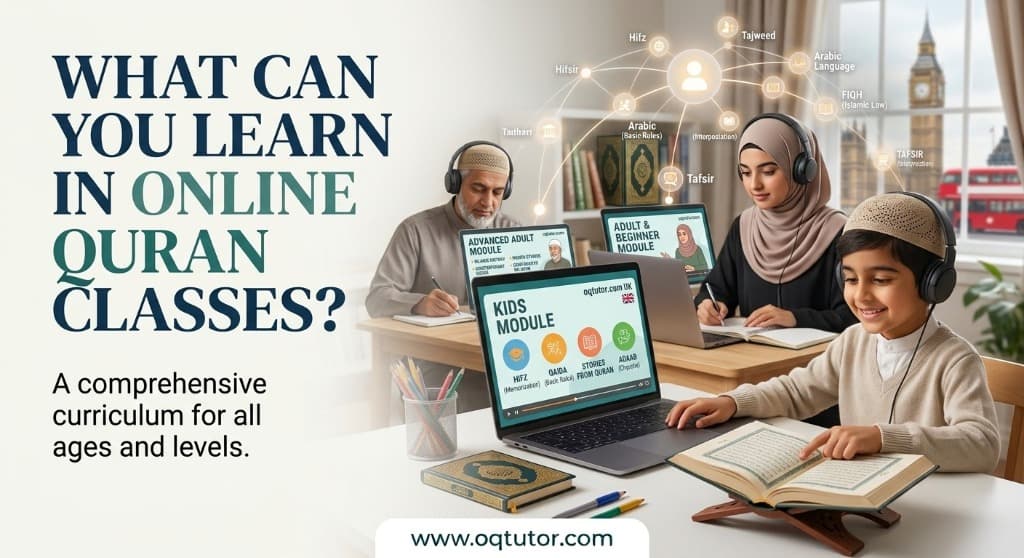
A structured Quran curriculum is designed to guide learners progressively from basic letter recognition to advanced, melodious recitation and memorisation:
Arabic Letters and Noorani Qaida
The foundation of Quranic reading begins with Noorani Qaida. Learners master letter shapes, joining letters, Harakat (Fatha, Kasra, Dammah), Tanween, Sukoon, and basic Madd elongation. For a deeper look at the beginner journey, explore our guide on the best online Quran classes for beginners.
Quran Reading
Once Qaida is completed, students begin direct Quran reading from the Mushaf, typically starting with short Surahs in Juz Amma. The teacher focuses on fluency, sentence rhythm, correct pausing (Waqf), and building reading confidence. Learn more about what to learn after completing Noorani Qaida.
Tajweed
Tajweed rules govern the accurate phonetics and recitation of the Quran. Students learn articulation points (Makharij), letter characteristics (Sifat), rules of Noon Sakinah and Meem Sakinah, and rules of elongation. Read our guide on how to improve your Quran pronunciation.
Quran Memorization
Students pursuing Quran memorisation (Hifz) follow a structured regimen balancing new memorisation (Sabaq) with systematic revision of recent lessons (Sabqi) and older Juz portions (Manzil) under direct tutor supervision.
Islamic Studies
Alongside Quran recitation, many UK programmes incorporate foundational Islamic studies, covering daily Duas, Salah steps, basic Seerah, and Islamic manners (Akhlaq) relevant to growing up as a young British Muslim.
How to Choose an Online Quran Teacher in the UK
The quality of your learning experience depends heavily on the competence and temperament of your instructor. When evaluating a Quran tutor for yourself or your children, consider these core factors:
Quran & Tajweed Qualifications
Verify that the teacher holds formal Islamic certification (such as an Ijazah in Tajweed or graduation from a recognised Islamic seminary). Authentic credentials ensure correct knowledge transmission.
Experience With Children
Teaching young children requires distinct pedagogical skills. A great tutor for children uses patience, positive encouragement, and age-appropriate explanations rather than strict criticism.
Clear Communication Skills
For students in the UK, teachers must communicate fluently in English (or Urdu/Arabic where preferred) so that complex Tajweed rules and concepts can be explained clearly and concisely.
Safeguarding & Student Safety
Reputable providers implement strict child protection measures, background vetting, recorded session audits, and open-door policies allowing parents to observe classes at any time.
What Parents Should Check Before Enrolling a Child
Before committing to an online Quran academy, parents should work through a practical checklist to ensure the programme aligns with their family's standards:

What Equipment Do You Need for Online Quran Learning?
Setting up an effective home learning station does not require expensive hardware. A basic, reliable setup includes:
Computer or Tablet
A laptop, desktop, iPad, or tablet with a clear screen for reading digital Mushaf pages.
Stable Internet
A standard home broadband or 4G/5G connection for uninterrupted audio and video streaming.
Headset with Microphone
Clear headphones help the student hear subtle pronunciation sounds without background household noise.
Webcam
Allows the teacher to observe mouth and lip movements during articulation for accurate Tajweed feedback.
Quiet Study Space
A quiet desk or corner away from television screens and family conversations promotes deep concentration.
Physical Mushaf / Qaida
Having a physical copy of Noorani Qaida or the Quran next to the screen reinforces daily off-screen revision.
How to Fit Quran Classes Around UK School and Work Schedules
One of the primary reasons UK families transition to online tuition is scheduling convenience. To build a sustainable routine that lasts throughout the academic year, keep these strategies in mind:
- Target after-school slots: Most children learn best between 4:00 PM and 7:30 PM (GMT/BST), after they have had a snack and decompressed from school.
- Utilise weekend mornings: Saturday and Sunday morning slots provide focused, unhurried learning before weekend family outings.
- Maintain consistency during half-terms: Online tuition allows families to keep classes running during school holidays or travel periods without losing momentum.
- Prioritise short, frequent sessions: Three to four 30-minute sessions per week produce significantly better long-term retention than a single long weekend class.
Online Quran Classes vs Local Mosque or In-Person Classes
Both online learning and local mosque classes offer valuable Islamic education. Choosing the best option depends on your family's lifestyle, location, and the student's individual learning style:
| Factor | Online Classes | In-Person Mosque Classes |
|---|---|---|
| Travel & Commute | Usually none (learn from home) | Requires daily or weekly travel |
| Scheduling | Often flexible around routine | Fixed schedule set by centre |
| Teacher Attention | Dedicated one-to-one focus | Varies (often group of 10–20) |
| Learning Environment | Safe, quiet home setting | Physical communal classroom |
| Social Interaction | Usually lower peer interaction | Higher local community bonding |
| Convenience | High for busy family routines | Depends on distance to centre |
Neither option is universally superior for every family. In-person classes foster direct community ties, while online classes offer unmatched flexibility, personalized pacing, and focused individual attention. For a deeper analysis, see our article on online vs in-person Quran classes.
How Beginners Can Start Learning Quran Online
Starting from zero can feel intimidating, but an incremental step-by-step roadmap makes the journey straightforward:
Assess Current Ability
Identify whether the learner knows Arabic alphabet letters or is beginning entirely from scratch.
Learn Arabic Letters
Master recognition of individual letters, their names, and distinct visual shapes.
Start Noorani Qaida
Work through phonetic vowel marks (Fatha, Kasra, Dammah) and letter combinations.
Practise Pronunciation
Develop accurate Makharij articulation through repeated teacher modelling and real-time correction.
Begin Direct Quran Reading
Transition from single-word exercises to reading complete verses in short Surahs of Juz Amma.
Introduce Foundational Tajweed
Apply rules such as Ghunnah, Ikhfa, and elongation while reciting.
Build Regular Practice
Establish 10–15 minutes of independent daily revision between live classes.
Review Progress & Set Goals
Regularly assess fluency milestones with your tutor and establish new memorisation or reading targets.
Questions to Ask Before Joining an Online Quran Academy
When contacting potential online academies, ask these questions to evaluate their professionalism and educational rigor:
Online Quran Learning With OQTutor
OQTutor provides personalized one-to-one online Quran classes designed specifically for UK learners of all ages. Students can explore structured learning tracks tailored to their individual goals, including Noorani Qaida, Quran Reading, Tajweed Mastery, Quran Memorisation, and Islamic Studies.
With certified male and female scholars, flexible British time zone slots (GMT/BST), and regular parent progress reporting, families can discover a supportive educational home. Learn more about OQTutor's online Quran classes in the UK to find a learning schedule that works for your household.
Frequently Asked Questions
Are online Quran classes suitable for beginners in the UK?
Yes. Complete beginners can start with Arabic letters, correct pronunciation, and Noorani Qaida before moving on to full Quran reading. A structured, one-to-one approach allows beginners of any age to learn at a comfortable, gradual pace without feeling overwhelmed.
What age can children start online Quran classes?
Many children are ready to begin around the age of four to six once they can follow simple instructions and sit for a short 25–30 minute lesson. However, developmental readiness, focus, and enthusiasm are far more important than a fixed starting age.
Can adults learn Quran online from the beginning?
Yes. Adult beginners can learn Arabic phonetics and Noorani Qaida from scratch, or return to study after many years to improve Tajweed and fluency. Private online lessons provide a supportive, confidential learning environment with timings tailored around work and family.
Do online Quran classes include Tajweed?
Yes. Most reputable online Quran classes integrate essential Tajweed principles, including Makharij (letter articulation points), Harakat (vowel rules), Noon Sakinah, and Ghunnah, with real-time feedback during recitation.
What should parents look for in an online Quran teacher?
Parents should look for formal Quran and Tajweed qualifications, proven experience teaching children, clear English communication skills, patience, safeguarding awareness, structured lesson methods, and a supportive demeanor.
How long is a typical online Quran lesson?
Most one-to-one online Quran lessons last 30 minutes. This provides an ideal duration for maintaining sharp focus and retention without causing fatigue, especially for young children balancing schoolwork.
Can Quran classes fit around UK school schedules?
Yes. Online classes offer flexible scheduling during weekday after-school hours (4:00 PM – 8:00 PM GMT/BST) or on weekend mornings, making it easy to establish a consistent routine without travel stress.
Do students need previous Arabic knowledge?
No previous knowledge of Arabic or Quranic reading is required. Absolute beginners start from letter recognition and basic phonetic sounds, progressing step by step toward confident, fluent recitation.
Final Thoughts
Choosing the right Quran education path is an important decision for every Muslim family in the UK. Whether you opt for a local madrasa or the convenience of one-to-one online tuition, the most vital ingredients for success are teacher quality, consistent practice, and an encouraging learning atmosphere.
By selecting a qualified teacher, following a systematic curriculum, and maintaining a regular weekly routine, students of all ages can develop accurate Tajweed, build strong recitation confidence, and cultivate a meaningful, lifelong connection with the Holy Quran.
Ready to Explore Online Quran Classes in the UK?
Book a free 30-minute placement trial with certified male or female Quran scholars. Experience personalized one-to-one learning on British time zone slots with zero obligation.

Muhammad Imran
Author & Senior ScholarSenior Tajweed & Hifz Scholar • Jamia Ashrafia Graduate
Muhammad Imran is a certified Tajweed and Quran memorisation scholar at OQTutor with over 5 years of international teaching experience guiding UK and international students through Noorani Qaida, accurate Makharij, and complete Quran recitation.