
Improving your Quran pronunciation is a gradual, rewarding journey centered on measured practice rather than speed. By understanding the articulation points (Makharij) of Arabic letters, isolating difficult sounds, practicing slowly, recording your recitation, and getting qualified feedback, you can build clear, accurate, and confident recitation.
Learning to read the Quran is a meaningful journey. For beginners, however, pronunciation can sometimes feel difficult. You may recognize an Arabic letter on the page but still struggle to produce its sound correctly.
This is completely understandable. Arabic has sounds that may be unfamiliar to people who grew up speaking English, Urdu, or another language.
The good news is that Quran pronunciation can improve with the right kind of practice. You do not need to learn everything at once. A better approach is to identify the sounds that give you trouble, understand how they are produced, and practice them carefully.
“...and recite the Quran with measured recitation.”
— Surah Al Muzzammil (73:4)
For a beginner, that idea is useful. Good recitation is not a race. Sometimes slowing down is exactly what helps you move forward.
What Does Correct Quran Pronunciation Mean?
Correct Quran pronunciation means producing Arabic letters and words accurately while following the principles of Quranic recitation.
One important part of this is Makharij (مَخَارِج), the articulation points of Arabic letters. In simple terms, Makharij helps you understand where a particular letter comes from when you pronounce it.
The sound may involve the throat, tongue, lips, or the open space inside the mouth.
This matters because some Arabic letters can sound very similar to a beginner. If you rely only on the closest sound from your native language, you may develop an incorrect pronunciation without realizing it.
Phonetic Distinctions in Quranic Arabic
The Quranic Arabic Corpus provides a phonetic transcription system for Quranic Arabic and distinguishes sounds such as:
That shows an important point: Arabic pronunciation contains distinctions that are worth learning carefully.
Why Is Quran Pronunciation Difficult for Beginners?
Unfamiliar Sounds
When learning a new language, people naturally connect unfamiliar sounds with sounds they already know. This makes letters easier to remember, but the closest familiar sound is not always the correct one.
Reading Too Quickly
When you rush through a passage, you have less time to think about the pronunciation of individual letters. A sound that needs extra attention can easily get lost in the flow of recitation.
Unnoticed Mistakes
You may not notice every mistake you make yourself. Another person or teacher can hear subtle differences that you have become accustomed to hearing incorrectly.
That is why listening and feedback are so useful. An experienced teacher or audio comparison helps calibrate your ear and mouth mechanics.
Start With the Articulation of Arabic Letters
If you want to improve your Quran pronunciation, learning the articulation of Arabic letters is a strong starting point.
You do not need to memorize every technical detail in one sitting. In fact, trying to do that can make Quran learning feel unnecessarily complicated. Start with a small group of letters and pay attention to how the sound is produced.
Some Arabic letters are produced in different areas of the throat (bottom, middle, and top). These sounds may require extra practice if your first language does not contain similar sounds. The important thing is not simply to memorize the letter—try to understand how it is physically produced.
The tongue is involved in the pronunciation of the largest group of Arabic letters. A small change in tongue position against the palate, gums, or teeth can change the resulting sound. This is why similar-looking or sounding letters require focused practice.
The lips play an important role in producing certain Arabic letters (such as Baa, Meem, and Waw). Watching yourself in a mirror can sometimes help you become more aware of your mouth position instead of relying only on what you hear.
Some sounds depend on the open acoustic space of the mouth and throat rather than a single point of physical contact, particularly the elongated vowel sounds (Madd letters). Learning these differences gradually makes Quran pronunciation much easier to understand.
Practice Difficult Letters on Their Own
If one Arabic letter is giving you trouble, do not keep reading entire pages and hope the problem disappears.
Take the letter out of the larger passage. Listen to its correct pronunciation. Say it slowly. Then practice it with different vowel sounds (Fatha, Kasra, Damma). Once the sound becomes more familiar, practice it inside a single word. Finally, return to the Quranic passage where you originally struggled.
Clear Progressive Learning Path:
The goal is not to read as quickly as possible. The goal is to produce the sound correctly and then gradually make it more natural.
Slow Down When You Practice
Many beginners think faster reading means better reading. It does not.
When you practice slowly, you have more time to notice what your tongue, lips, and throat are doing. You can also pay closer attention to vowels and the qualities of individual letters.
The Quran instructs believers to recite with measured recitation in Surah Al Muzzammil 73:4. So when you slow down during practice, you are not doing something strange. You are giving yourself room to concentrate.
Think about learning to write: You would not expect a beginner to write the alphabet at full speed on the first attempt. Pronunciation works in much the same way. Accuracy comes first; speed can develop later.
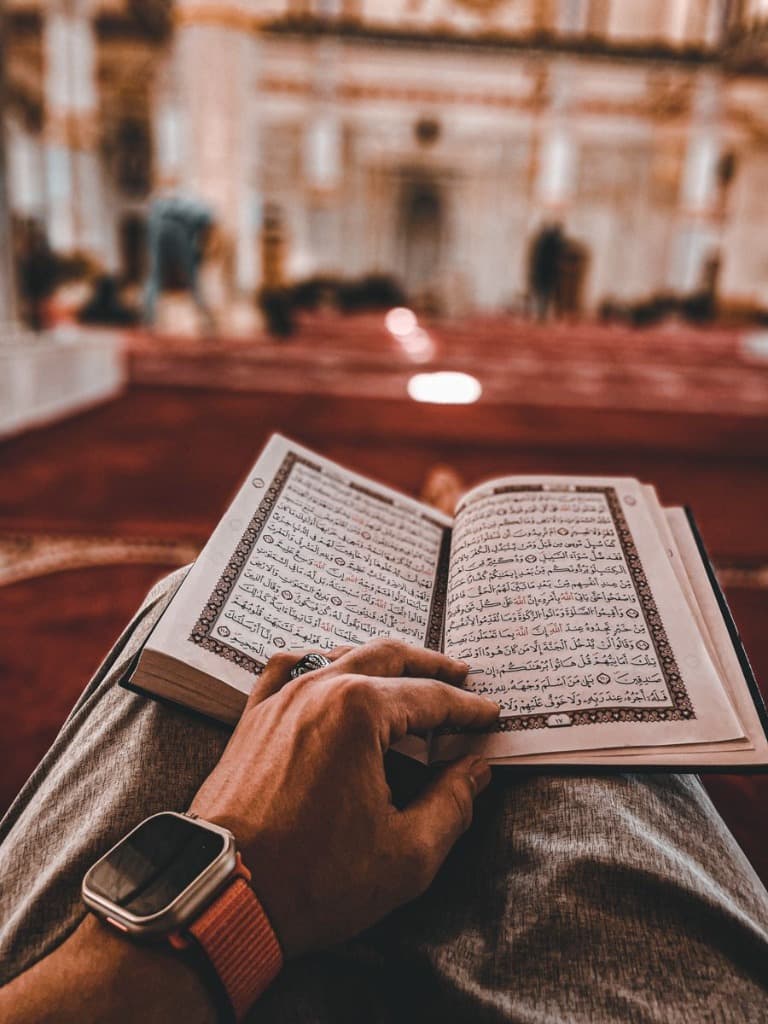
Practicing Quran recitation slowly and attentively with an open Mushaf enables beginners to isolate difficult sounds and master articulation without rushing.
Listen Before You Repeat
Good pronunciation practice starts with careful listening.
Choose a reliable Quran recitation and listen to a short passage. Do not worry about completing a whole page. Instead, focus strictly on the sounds.
Ask Yourself While Listening:
- 1Which letter sounds difficult?
- 2Where does the sound seem to come from?
- 3Is the sound clear?
- 4Am I adding or losing a sound?
- 5Does my pronunciation change when I read faster?
Then repeat the short passage. Listen again. Repeat it again. It may sound simple, but focused repetition is much more useful than repeating something without knowing what you are trying to improve.
The Quranic Arabic Corpus also provides detailed linguistic and phonetic resources for Quranic Arabic to support this step.
Record Your Own Recitation
Your phone can become a surprisingly useful practice tool.
Choose a short passage and record yourself reading it. Then listen to the recording carefully.
Do not try to find every possible mistake. Choose one. Perhaps one letter does not sound clear. Maybe you rush through a word. Or perhaps your pronunciation changes when you become more comfortable with the passage. Focus on that one issue, practice it, and then record yourself again.
Read → Record → Listen → Identify → Practice → Repeat
You do not need expensive equipment. For basic self-review, a simple phone voice memo is more than enough.
Learn Pronunciation Alongside Tajweed
Pronunciation and Tajweed are closely related, but they are not exactly the same thing.
Pronunciation concerns how you physically produce individual letters and words. Tajweed provides principles and rules that guide Quranic recitation as a whole.
However, you do not need to learn every rule immediately. Start with the sounds you are struggling with. Understand the articulation, practice the sound, and then gradually learn the relevant Tajweed rules.
That approach is much easier than trying to memorize a long list of terminology before you have developed a feel for the sounds. You can explore our foundational Beginner's Guide to Mastering Tajweed Rules for additional structured guidance.
Get Your Pronunciation Checked
Self-practice is useful, but it has an obvious limitation: you may not know that you are making a mistake.
A qualified Quran teacher can listen to your recitation and point out pronunciation problems that you may not notice yourself.
Good correction should also be specific. Instead of simply hearing, “That letter is wrong,” you should understand what needs to change. A teacher can explain the position of your tongue, lips, or throat and then give you an opportunity to try again.
This kind of immediate feedback makes practice much more productive and prevents you from repeatedly practicing the same mistake until it becomes deeply ingrained.

Receiving real-time correction from a qualified Quran tutor—whether in live 1-on-1 online classes or in person—ensures subtle pronunciation mistakes are caught and corrected immediately.
Do Not Focus on Having a Beautiful Voice First
It is natural to admire skilled Quran reciters. Their voices, rhythm, and recitation can be inspiring. But beginners should not feel pressured to imitate the entire style of an experienced reciter.
Pronunciation comes first. A beautiful voice does not replace correct articulation.
Focus on producing the letters clearly. Once your pronunciation becomes more reliable, you can gradually work on fluency and the natural beauty of your recitation.
The Quranic instruction to recite in a measured manner gives beginners a useful reminder to value careful recitation rather than simply rushing through the words.
A Simple Quran Pronunciation Practice Routine
You can keep your practice simple. You do not need a complicated timetable.
Choose One Difficult Sound
Pick one letter or sound that you regularly struggle with during recitation.
Listen Carefully
Listen to a reliable recitation and pay attention specifically to that particular sound.
Practice Slowly
Repeat the isolated sound several times without rushing or forcing tension.
Practice It in a Word
Once the sound feels more familiar, pronounce it inside a single Quranic word.
Read a Short Passage
Return to a short section of the Quran (1-2 verses) and apply what you have practiced.
Record Yourself
Make a short voice recording on your phone and listen to evaluate your clarity.
Ask for Feedback
If you still cannot tell whether the pronunciation is correct, ask a qualified Quran teacher to check it.
This method keeps your practice focused. Instead of trying to fix everything at once, you work on one problem at a time.
Common Pronunciation Mistakes Beginners Should Avoid
Trying to Fix Everything at Once
Arabic pronunciation has many details. Trying to correct every sound during one session can become overwhelming. Work on one or two clear issues first.
Reading Too Quickly
Speed makes it harder to notice pronunciation problems. Slow down during practice and give yourself enough time to produce each sound carefully.
Copying Without Understanding
Listening and repeating are valuable, but you should also understand what you are trying to change. Knowing the articulation point gives your practice clear direction.
Ignoring Repeated Mistakes
If you keep making the same pronunciation mistake, do not simply read past it. Stop, practice the difficult sound separately, and then try the word again.
Avoiding Correction
If you are unsure about a letter, ask someone qualified to listen. A small correction today prevents an incorrect pronunciation from becoming a long-term habit.
How Long Does It Take to Improve Quran Pronunciation?
There is no single number of days that works for every learner.
People begin at different levels. Their Arabic background, pronunciation difficulties, practice habits, and access to feedback can all differ.
Instead of setting an artificial deadline, look for practical signs of improvement:
These milestones tell you more about your genuine progress than any arbitrary promise that pronunciation will improve in a fixed number of days.
Can You Improve Quran Pronunciation Without a Teacher?
Yes, you can practice many aspects of pronunciation on your own. Listening, repeating, recording yourself, and practicing slowly can all help.
But independent practice has a limitation: if you do not know that a particular sound is incorrect, you may keep repeating it in the same way.
This is where teacher feedback becomes valuable. A teacher can identify the problem, explain what needs to change, and listen again as you practice.
The two approaches work best together. Guided learning gives you direction, while personal practice gives you opportunities to apply what you have learned.
Final Thoughts
Improving your Quran pronunciation does not require you to become an expert overnight.
Start small. Learn how difficult letters are articulated. Practice one sound at a time. Listen carefully. Slow down when necessary. Record yourself and ask for feedback when you are unsure.
Most importantly, do not become frustrated when a particular Arabic sound takes time to learn. Some sounds may feel strange at first because your mouth is simply not used to producing them. That is part of learning.
Your first attempt does not have to sound like your hundredth attempt.
With patient practice and proper guidance, you can continue developing clearer and more accurate Quran recitation.
Get Your Quran Pronunciation Checked for Free
Book a free 1-on-1 trial class with certified male or female Quran teachers at OQTutor. Receive personalized feedback on your Makharij and start reciting with accuracy.
Frequently Asked Questions
Q:How can I improve my Quran pronunciation?
Start by identifying the Arabic sounds that you find difficult. Learn their correct articulation, listen to reliable recitation, practice slowly, and ask a qualified Quran teacher for feedback when needed.
Q:What should I learn first to improve Quran pronunciation?
Learning the correct articulation of Arabic letters is a useful foundation. Makharij helps learners understand where different Arabic letters are produced.
Q:Why are some Arabic letters difficult for beginners?
Some Arabic sounds may not exist in a learner’s first language. As a result, beginners may naturally replace an unfamiliar sound with one that feels more familiar.
Q:Does Tajweed help with Quran pronunciation?
Yes. Tajweed includes principles and rules that guide Quranic recitation, while correct articulation of Arabic letters forms an important part of accurate recitation.
Q:Should I practice Quran pronunciation slowly?
Slow practice can help you concentrate on individual sounds and notice pronunciation problems. Once you become more comfortable, you can gradually work toward a natural reading pace.
Q:Can a Quran teacher correct my pronunciation?
Yes. A qualified Quran teacher can listen to your recitation and give specific feedback about articulation and pronunciation.
Sources & References
- Quran.com, Surah Al Muzzammil 73:4, which presents the Quranic instruction to recite with measured recitation.
- Quranic Arabic Corpus, a linguistic resource providing phonetic transcription and grammatical information for Quranic Arabic.

Muhammad Imran
Author & Senior ScholarSenior Tajweed & Hifz Scholar • Jamia Ashrafia Graduate
Muhammad Imran is a certified Tajweed and Quran memorisation scholar at OQTutor with over 5 years of international teaching experience guiding young children and adult beginners through Noorani Qaida, accurate Makharij, and complete Quran recitation.