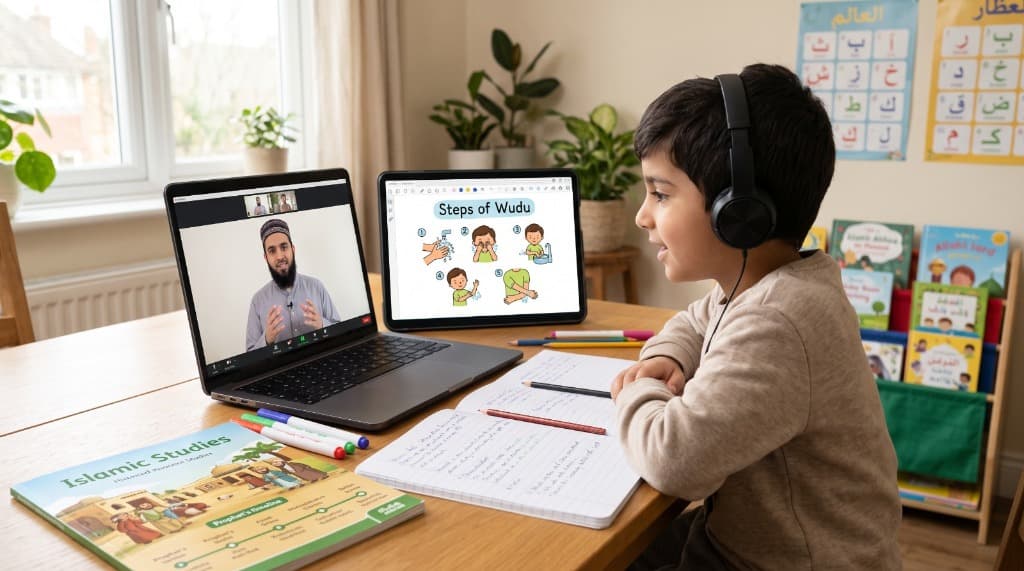
For Muslim parents raising children in the USA, UK, Canada, Australia, Europe, and Singapore, teaching kids to read the Holy Quran is usually the first priority.
Yet many parents eventually notice a common gap: a child may recite Arabic fluently, but still not know how to pray Salah properly, why we fast in Ramadan, or how to handle peer pressure with a confident Muslim identity.
What Does a Complete Online Islamic Studies Curriculum Cover?
A well-rounded online Islamic Studies curriculum for kids goes beyond Quran recitation and covers six foundational pillars:
In this guide, we break down what a structured Islamic Studies syllabus looks like, share an age-by-age roadmap (ages 4 to 16), and show how to pair Islamic Studies with your child's Quran classes.
Why Quran Recitation Alone Isn't Enough for Kids Growing Up in the West
Learning Noorani Qaida and reading the Quran with Tajweed gives your child the ability to read the Book of Allah accurately. Without dedicated Islamic Studies, however, children can start to see Quran class as a reading exercise rather than a complete way of life.
Children in non-Muslim-majority countries spend roughly 30 to 35 hours a week in secular schools, where they absorb many messages that differ from what they learn at home. A structured 1-on-1 Islamic Studies curriculum helps your child:
Build Strong Faith (Iman)
Understand who Allah is and why we worship Him, with warm, wise answers to their natural questions in a safe, judgment-free environment.
Practice Islam Independently
Move from blindly copying parents during prayer to knowing the steps, rulings, and spiritual meanings of Wudu and Salah on their own.
Develop Prophetic Character (Akhlaq)
Learn honesty, gratitude, kindness to neighbors, and respect for parents through real examples from the Sunnah of Prophet Muhammad ﷺ.
Feel Confident in Their Muslim Identity
Connect with the history of the Prophets and the Companions (Sahaba) so they feel proud, resilient, and unapologetic about their faith in secular classrooms.
The Role of Parents: Parents also play an irreplaceable part. Our guide on the role of parents in Islamic education in non-Muslim countries explains how home and class can reinforce each other, and a good tutor builds on what you already teach at home.
If your child struggles with focus, our post on motivating children in online Quran classes has practical tips you can start using today.
The 6 Core Pillars of a Complete Online Islamic Studies Curriculum
When evaluating an online Islamic academy for your child, look for a syllabus that balances heart-softening stories with practical daily worship across these six foundational subjects.
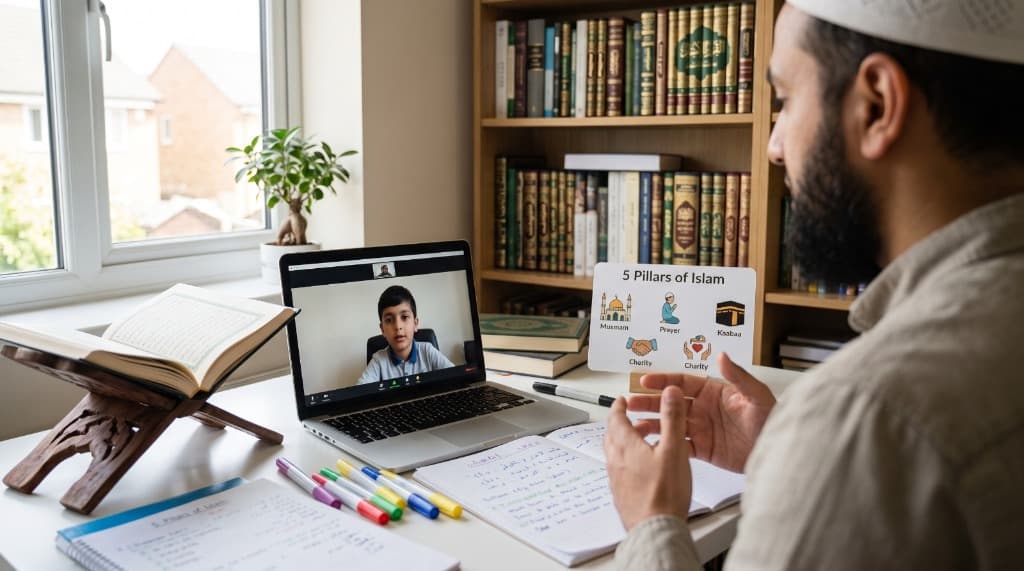
Aqeedah (Islamic Beliefs & Knowing Allah)
Aqeedah is the foundation of a child's faith. Rather than starting with dry theological terms, a great curriculum introduces Allah through His creation, His boundless mercy, and His Beautiful Names (Asma ul-Husna).
The Six Articles of Faith (Iman): belief in Allah and His Oneness (Tawheed), the Angels (Mala'ikah), the Revealed Books (Kutub), the Prophets and Messengers (Rusul), the Day of Judgment (Yawm al-Qiyamah), and Divine Decree (Qadr).
Fiqh & Ibadah (Practical Worship & Pillars of Islam)
Children learn best by doing. Fiqh for kids focuses on the Five Pillars of Islam and the everyday rulings of purification and prayer, taught in line with your family's madhab where possible.
Cleanliness (Taharah), step-by-step Wudu (ablution) and Tayammum, the conditions and actions of the five daily Salah, what breaks Wudu and Salah, fasting in Ramadan, Zakat basics, and the spiritual journey of Hajj.
Seerah & Stories of the Prophets (Qasas ul-Anbiya)
Children naturally love stories. Teaching the life of Prophet Muhammad ﷺ (Seerah) and the stories of earlier Prophets, from Adam, Nuh, and Ibrahim to Musa and Isa (peace be upon them all), anchors moral lessons in unforgettable narratives.
The birth and youth of the Prophet ﷺ in Makkah, the revelation of the Quran, patience during persecution, the Hijrah to Madinah, stories of inspiring young Companions such as Ali ibn Abi Talib (RA), Anas ibn Malik (RA), and Mus'ab ibn Umayr (RA), and lessons from the Prophets mentioned in the Holy Quran.
Daily Masnoon Duas & Short Hadith
Memorizing short supplications connects a child to Allah from the moment they wake up until they go to sleep, turning everyday moments into acts of remembrance (Dhikr).
40+ essential Masnoon Duas (waking up, before and after eating, entering and leaving the home and washroom, traveling, seeking knowledge, and Duas for parents), alongside short, easy Hadith from Arba'een An-Nawawi on pure intentions (Niyyah), truthfulness, and kindness.
Akhlaq & Adab (Islamic Manners & Character Building)
In Islam, good character weighs heavily on the scale of deeds. An effective online tutor reinforces the moral values and courtesies you teach at home.
Respecting parents (Birr al-Walidayn), speaking truthfully, the Islamic greeting (Assalamu Alaikum), eating and sleeping etiquette, controlling anger, choosing righteous friends, and handling modern challenges like excessive screen time, digital etiquette, and peer bullying.
Kid-Friendly Tafsir of Juz Amma
As children memorize short Surahs in Hifz-ul-Quran or Quran reading classes, Islamic Studies bridges the gap by explaining the meaning, stories, and context behind what they recite.
The meaning and reason for revelation (Asbab an-Nuzul) behind Surah Al-Fatiha, Al-Ikhlas, Al-Falaq, An-Nas, and the rest of the 30th Juz, making daily prayers deeply meaningful.
Age-by-Age Breakdown: What to Teach Your Child at Every Stage
A 5-year-old and a 13-year-old cannot learn from the same syllabus. At OQTutor, our Islamic Studies curriculum adapts dynamically to four distinct developmental stages:
| Age Group | Learning Stage | Core Curriculum Focus | Expected Milestones |
|---|---|---|---|
| Ages 4–6 | Early Foundations (Love & Habit) | Knowing Allah as our Creator and Provider; the 5 Pillars of Islam through stories, rhymes, and vocal-only nasheeds; 10–15 short daily Duas; basic manners (Bismillah, right hand); stories of Prophets Adam, Nuh, and Yunus (AS). | Says Bismillah and Alhamdulillah naturally, knows the 5 Pillars, and loves stories about the Prophet ﷺ. |
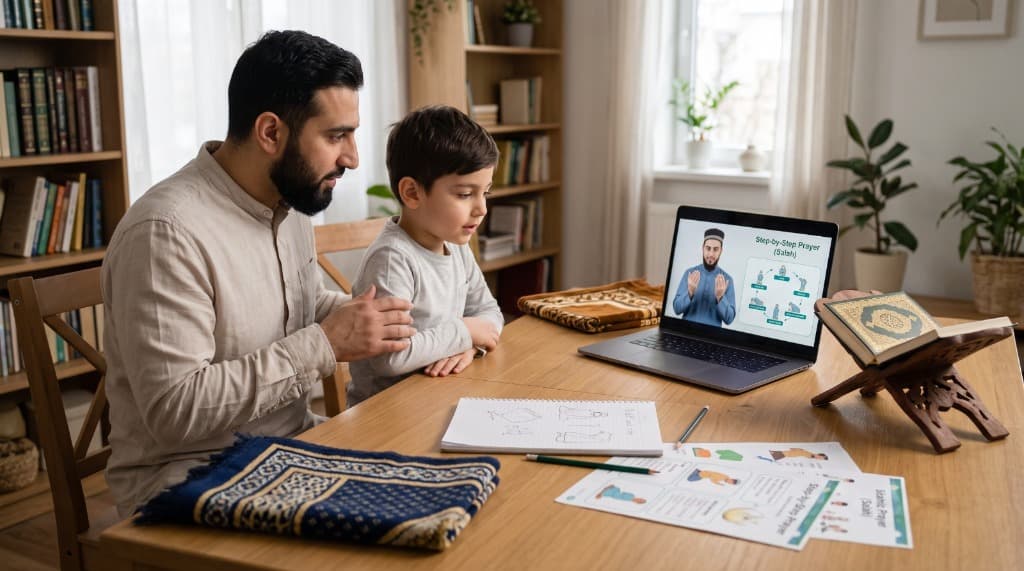
| Ages 7–9 | The Prayer Age (Practical Worship) | Step-by-step Wudu and Salah training; Tashahhud, Durood, and Dua Qunoot; the 6 Articles of Faith; the Makkan period of the Seerah; manners with parents, siblings, and teachers. | Performs Wudu and prays a complete 2-, 3-, or 4-Rakah Salah independently, with understanding. |
| Ages 10–12 | Pre-Teen Mastery (Responsibility & Depth) | Rules of fasting, Zakat basics, and correcting mistakes in Salah (Sujood as-Sahw); the Madinan period of the Seerah and the Khulafa al-Rashidun; Tafsir of Juz Amma Surahs; 20+ Hadith with practical application. | Prays the five daily prayers consistently, practices fasting, and understands the meaning of the Surahs they recite. |
| Ages 13–16 | Teen Identity (Conviction & Ethics) | Answering modern doubts and strengthening Aqeedah; fiqh of puberty, halal and haram lifestyle, and modesty (Haya); Islamic history and role models; peer pressure, social media ethics, and resilience through Tawakkul. | Feels confident in their Muslim identity, understands adult fiqh obligations, and applies Islamic ethics independently. |
Not sure which stage fits your child?
Start a 3-day free trial and our senior scholar will assess your child's level, reading background, and learning goals in the first class.
1-on-1 Online Islamic Studies vs. Weekend Sunday School: Which Is Better?
Many families enroll their children in mosque weekend schools, which are wonderful for community bonding. However, weekend schools often place 15 to 25 children of varying levels in one classroom for only a couple of hours a week.
That is why many families across the USA, UK, Canada, and Australia pair—or replace—weekend school with 1-on-1 online Islamic Studies:
Personalized Pacing & Safe Questions
Shy children and teens often hesitate to ask sensitive questions in a crowded room. In a private session with a dedicated male or female tutor, your child gets the teacher's full attention and can ask anything openly.
Integrated Quran + Islamic Studies
Instead of driving to multiple classes, your child can spend 20–25 minutes on Tajweed or Hifz and 10–15 minutes on Islamic Studies and Duas in the same 30–40 minute session, maximizing learning efficiency.
Zero Commute & Flexible Times
Whether your family is balancing sports, secular school homework, or changing daylight saving hours, private online classes fit directly into your weekly family schedule.
Frequently Asked Questions (FAQ)
Answers to common questions from parents considering online Islamic Studies for their children:
Give Your Child the Gift of Complete Islamic Knowledge
Teaching your child to read the Quran is a tremendous blessing. Helping them understand, love, and live by Islam may be a source of ongoing reward (Sadaqah Jariyah) for your family in this life and the Hereafter.
At OQTutor, our structured Islamic Studies course is designed for kids and teens growing up in the USA, UK, Canada, Australia, Europe, and Singapore. With interactive lessons and caring 1-on-1 teachers, we make learning about Allah and His Messenger ﷺ the highlight of your child's week.