If you grew up speaking English in Chicago, London, or Sydney, your throat has lived a very peaceful and relaxed life. English speakers produce almost every consonant at the front of the mouth using the lips, teeth, and the tip of the tongue. Then you open your first Noorani Qaida lesson, meet the letter Ayn (ع) or Qaaf (ق), and suddenly your vocal cords feel like they are doing gymnastics without a warmup.
Do not worry. Every non Arab beginner goes through this exact phase. You are not bad at languages. You are simply waking up vocal muscles that English never asked you to use.
Makharij al Huruf (points of articulation) refers to the seventeen specific anatomical locations in the throat, tongue, lips, nose, and mouth where Arabic letters originate, as codified by classical scholars like Imam Ibn al Jazari. To master the two hardest categories for English speakers, you must learn Al Halq (the six throat letters divided into bottom, middle, and top throat zones) and Al Isti'la (the seven permanently heavy letters summarized in the classical phrase Khussa Daghtin Qidh, which require raising the back of the tongue toward the soft palate).

Why Exact Letter Pronunciation Matters in Quran Recitation
In English, if someone pronounces the word "water" with a British accent, a Texas drawl, or a New York accent, the meaning stays identical. You still get a glass of water.
Classical Arabic works on a much stricter phonetic system. Changing the exit point (Makhraj) of a single letter frequently changes the entire root word and flips the meaning of a Quranic verse.
Consider two famous examples that every Quran with Tajweed teacher corrects in week one:
1. Qalb (قَلْب) vs. Kalb (كَلْب)
Meaning ShiftWhen you pronounce the word with a deep, heavy Qaaf (ق) from the very back of the tongue, Qalb means "heart." If you slip into an English habit and pronounce it with a light Kaaf (ك), the word becomes Kalb, which means "dog." Imagine reciting a verse about a pure heart in prayer and accidentally swapping those two sounds.
2. Alim (عَلِيم) vs. Alim (أَلِيم)
Theological AccuracyPronounced with a deep middle throat Ayn (ع), Alim means "All Knowing," one of the majestic names of Allah. If you replace that Ayn with a soft Hamzah (أ) from the bottom of the throat, the word turns into Alim, which means "painful" (as in a painful punishment).
In his foundational 15th century treatise Muqaddimah al Jazariyyah, the great scholar of Quranic sciences Imam Muhammad ibn al Jazari wrote that before a reciter starts reading, they must first know the articulation points (Makharij) and characteristics (Sifat) of the letters so they can speak the purest language. When we give every letter its rightful place, we protect both the beauty and the exact meaning of Allah's words.
What Are the 5 Major Areas of Makharij al Huruf?
According to the majority scholarly view established by the grammarian Al Khalil ibn Ahmad al Farahidi and affirmed by Imam Ibn al Jazari, the Arabic alphabet uses 17 specific articulation points grouped into 5 major vocal regions:
Al Jawf (The Empty Space of the Mouth and Throat)
Produces the three long vowel sounds (Madd letters: Alif, Waw, and Ya).
Al Halq (The Throat)
Produces six distinct guttural consonants across three levels.
Al Lisan (The Tongue)
The busiest muscle in Arabic, containing 10 articulation points that produce 18 different letters.
Ash Shafatan (The Two Lips)
Produces four letters (Fa, Ba, Meem, and Waw).
Al Khayshoom (The Nasal Passage)
Produces the Ghunnah (nasal resonance) attached to the letters Noon and Meem.
For native English speakers and Western children, the lips and the front of the tongue come naturally. The real challenge happens in Al Halq (the throat) and at the back of Al Lisan (the heavy letters). Let us tackle both step by step.
Mastering Al Halq: The 6 Throat Letters Made Simple
English only has one true throat letter: the soft letter "H" in words like house or hello. Arabic has six throat letters, neatly organized into three floors like an apartment building.
1. The Bottom of the Throat (Aqsa al Halq): ء and هـ
Located at the deepest part of the throat near the vocal cords and chest:
- Hamzah (ء): Produced by briefly closing the vocal cords and releasing air sharply. You actually make this exact sound in English without realizing it! It is the tiny pause in the middle of the expression "uh oh."
- Haa (هـ): A soft, breathy sound from the chest area, identical to the English "H" in hat. Just make sure it comes cleanly from the bottom of the throat without scraping.
2. The Middle of the Throat (Wasat al Halq): ع and ح
This is the zone that requires the most practice for beginners. Both sounds happen by gently narrowing the epiglottis in the center of your throat:
- Haa (ح): A sharp, warm, whispery sound with zero vocal cord vibration. Imagine you are standing outside on a freezing winter morning in Michigan or Toronto, and you breathe warm air onto your cold hands or fog up a pair of glasses. That smooth, friction filled exhale is ح.
- Ayn (ع): The voiced twin of ح. Use the exact same middle throat muscles, but turn on your voice box. A helpful trick from our tutors is to start saying the letter ح, hold the constriction in the middle of your throat, and immediately hum a vowel sound (Aa, Ee, Oo). Avoid squeezing your nose; Ayn belongs strictly in the throat.
3. The Top of the Throat (Adna al Halq): غ and خ
Located at the highest part of the throat right where it meets the soft palate (the root of the mouth):
- Khaa (خ): A dry, scraping sound similar to the Scottish word "Loch" or the sound someone makes when clearing a tickle at the top of their throat.
- Ghayn (غ): The voiced twin of خ. If you have ever gargled warm salt water in the morning, you already know how to pronounce غ. It is a smooth, vibrating gargle at the very top of the throat, similar to the French "R" in Paris.
Mastering the 7 Heavy Letters (Huruf al Isti'la)
Have you ever listened to a skilled Qari recite in Makkah and wondered why their voice sounds so rich, echoing, and full? That fullness comes from Tafkheem (heaviness), which is produced through an anatomical action called Isti'la (elevation).
In classical Tajweed, seven letters are permanently heavy under all circumstances. Scholars combined these seven letters into a famous memory phrase: خُصَّ ضَغْطٍ قِظْ (Khussa Daghtin Qidh).
How to Create a Heavy Sound Without Puckering Your Lips
Here is the number one mistake beginners make when trying to sound heavy: they round their lips into an "O" shape.
In authentic Tajweed, you only round your lips when pronouncing the letter Waw (و) or the short vowel Dammah (ُ). If you pucker your lips on a heavy letter with a Fathah (like Qaala), the sound becomes muffled and unnatural.
Instead, heaviness happens entirely inside your mouth:
Drop your lower jaw slightly to create vertical space inside your mouth cavity.
Raise the back of your tongue (Aqsa al Lisan) up toward the soft roof of your mouth, just like you do when you yawn or swallow a spoonful of peanut butter.
Let the sound bounce off the roof of the mouth so it echoes inside the oral cavity rather than escaping flatly out the front.
Side by Side Comparison: Heavy vs. Light Lookalike Pairs

The easiest way to train your ear and tongue is to practice heavy letters right next to their light counterparts. Notice how the tip of your tongue touches almost the same spot, while the back of your tongue does the heavy lifting:
| Heavy Letter (Isti'la) | Light Twin (Istifal) | Where the Sound Changes | Common Quranic Example |
|---|---|---|---|
| ق (Qaaf) | ك (Kaaf) | Qaaf hits the soft fleshy palate at the very back; Kaaf hits the hard palate slightly forward with air. | Khalaqa (He created) vs. Malik (King) |
| ص (Saad) | س (Seen) | Both whistle behind the lower teeth, but Saad lifts the back of the tongue for a deep, hollow echo. | As Sirat (The Path) in Surah Al Fatiha |
| ط (Taa) | ت (Taa) | Both touch the upper gum line, but ط is heavy and explosive with zero breathiness, while ت is light and airy. | At Tammah (The Overwhelming Calamity) |
| ظ (Dhaa) | ذ (Dhal) | Both place the tongue tip gently under the upper front teeth; ظ raises the back of the tongue for fullness. | Adh Dhalimeen (The Wrongdoers) |
| ض (Daad) | د (Daal) | Daad presses the sides of the tongue against the upper molars; Daal uses only the tongue tip behind the front teeth. | Walad Dalleen at the end of Surah Al Fatiha |
3 Practical At Home Drills to Train Your Tongue and Throat
You do not need an hour a day to fix your Makharij al Huruf. Like physical therapy, short daily repetitions build muscle memory fastest.
1. The Cold Glass Test for Haa (ح) vs. Haa (هـ)
Hold the palm of your hand two inches in front of your mouth. Say هـ (like hello). You will feel a puff of air, and your throat stays wide open. Now whisper ح by narrowing the middle of your throat as if fogging up a mirror. You should feel a warm stream of air and hear a crisp friction sound. Repeat "Ha, Hee, Hoo" five times before starting your daily Quran Reading practice.
2. The "Alif" Mirror Check for Heavy Letters
Sit in front of a mirror or open your laptop camera. Recite the seven heavy letters with a long Alif: Khaa, Saa, Daa, Ghaa, Taa, Qaa, Dhaa. Watch your lips closely. Your mouth should open vertically (up and down), never rounding into a circle. If your lips pucker, relax your face and focus on lifting the back of your tongue instead.
3. The Sukoon Echo Test
According to Imam Ibn al Jazari, the easiest way to locate the exact exit point (Makhraj) of any Arabic letter is to place a Sukoon (resting sign) on the letter and put a Hamzah before it. For example, say أَقْ (Aq), أَعْ (A'), أَطْ (At), or أَغْ (Agh). Where the sound stops dead in your throat or mouth is that letter's true home.
Why You Cannot Master Makharij from YouTube Videos Alone
Reading diagrams and watching recorded videos gives you a fantastic mental map. However, your own ears hear your voice through bone conduction inside your skull, which means your pronunciation sounds different to you than it does to a listener.
Throughout fourteen centuries of Islamic history, the Quran has been passed down through Talaqqi (face to face oral transmission). Even the Prophet Muhammad ﷺ reviewed the Quran orally with the Angel Jibril every Ramadan, as recorded in Sahih al Bukhari (Hadith 4997).
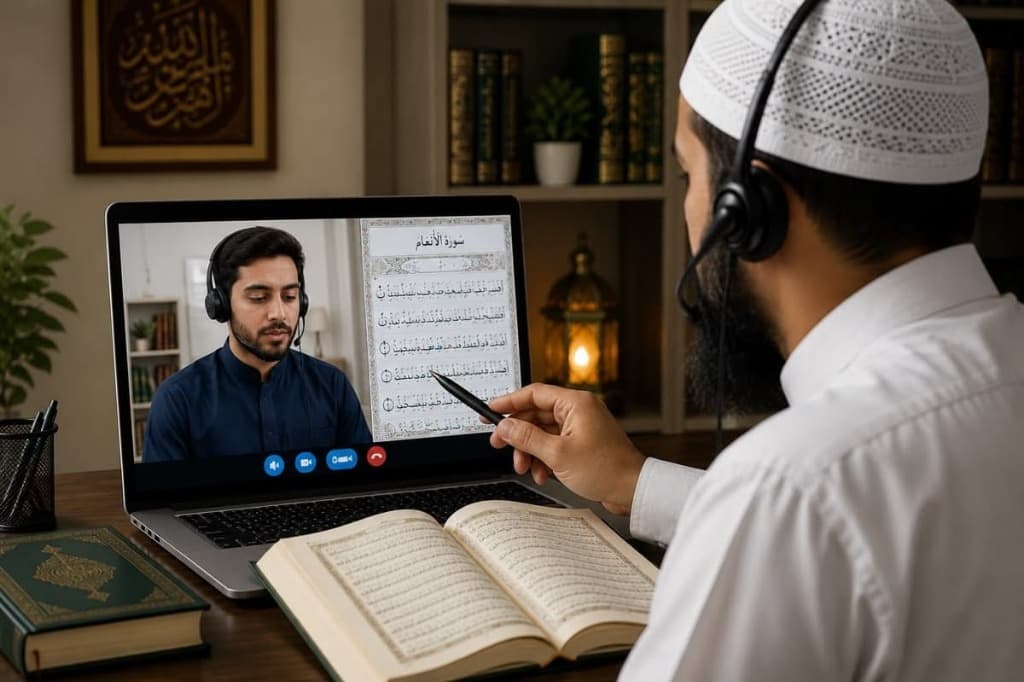
When you study in a live 1 on 1 online class, a certified tutor watches your jaw placement, listens to the resonance of your throat letters, and gives you instant feedback the second a heavy Saad slips into a light Seen. What takes six months of guessing on your own often clicks in two or three live sessions with a skilled teacher.
Frequently Asked Questions (FAQ)
Perfect Your Recitation with a Certified 1 on 1 Tajweed Tutor
There is nothing quite like the feeling of reciting Surah Al Fatiha or your favorite Surah in prayer and hearing every heavy letter and throat sound flow clearly and effortlessly.
At OQTutor, our certified male and female instructors specialize in helping children and adults across the USA, UK, Canada, and Australia master Makharij al Huruf and Tajweed in a warm, encouraging 1 on 1 environment. No pressure, no judgment, just clear step by step coaching tailored to your voice.